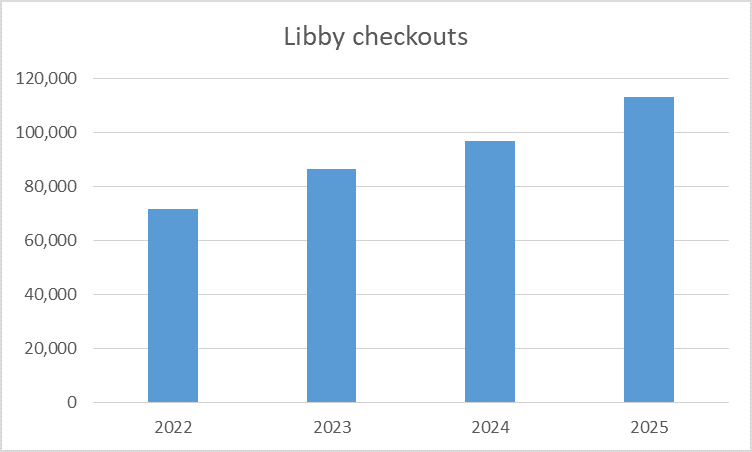
If you’ve placed a hold on a popular ebook or audiobook through Libby and watched the queue stretch out for weeks, you’re in good company. Digital borrowing at Hoboken Public Library has climbed steadily over the past several years, as you can see in the graph above, and for many of you it’s now the main way you read. The wait times that come with that are one of the most common questions we hear, so we wanted to walk through what’s actually going on behind the scenes.
Why does my ebook hold take so long?
A library’s digital collection works differently than the digital copy you buy on your own from a commercial retailer. When you buy an ebook for yourself, you typically keep it on your device indefinitely. When the library makes that same title available to customers, we license a digital copy under terms set by the publisher. Most current popular titles are licensed under “one user at a time” terms, much like a print copy. If the library has three licensed copies and forty-seven people on the hold list, the math works the same way it does for print. Customers move through the queue in the order they joined.
Here’s a concrete example. A recent bestseller like Yesteryear by Caro Claire Burke costs about $15 as a personal ebook purchase. The library’s license for the same title is around $55, and that license expires after two years. A bookstore can restock a popular title from a warehouse, but our digital collection works differently. Each additional copy comes as a separate license at the same per-copy price, and most expire on the same clock.
Why don’t you just license more copies?
We do, especially for high-demand titles. Hoboken Public Library’s digital materials budget has grown substantially over the past five years, and digital now accounts for more than half of what we spend on the collection. We watch hold ratios closely and add licenses where the queue justifies it.
Spending alone leaves the wait in place, though. A growing share of every library’s digital budget goes to buying additional copies of titles that are already in the collection, just to bring down hold lists on popular books. Every license expires on the publisher’s clock, so that spending maintains access for a defined period rather than building a permanent collection. If we doubled the digital budget tomorrow, you’d see shorter waits in the near term and the same waits returning as licenses expired and had to be renewed. It’s a different math than the one that governs print, where a book bought once can stay on the shelf for as long as it’s useful to the community.
Are there different ways to license the same book?
Yes, and the landscape has been shifting in a way worth knowing about. For some titles, the platform now offers more than one type of license for the same book, and the choice we make shapes what the wait looks like.
Take Yesteryear by Caro Claire Burke again. Hoboken’s eBCCLS digital collection runs through BCCLS, the 78-library consortium we belong to, so the copies and holds we’re about to describe are shared across the region. As of July 8, 226 BCCLS copies of Yesteryear are checked out and 1,309 customers are waiting. That’s roughly six customers per copy, with a wait list of at least five months. For that title, the consortium can license a one-year copy at $27.50, a two-year copy at $55, or pay roughly $5.50 each time any customer checks out the title (“cost per circ”), with every customer able to borrow it immediately. The first two options are “one user at a time” licenses, which is what creates the hold list in the first place. The third lets any number of customers borrow the same title at the same moment, which is what gives every customer instant access. The trade is that our cost grows with every checkout, scaling directly with use. With 1,309 customers already waiting and demand likely to continue, the third option would quickly run to several thousand dollars on a single title before the demand even settles.
We make these calls title by title, weighing how long the demand is likely to last, how many copies we’d need, and what we can sustain across the rest of the collection. The right answer varies by title. A title with a sharp spike of interest that fades in three months calls for a different bet than a title with steady demand over years.
Here is how the math breaks down for a single copy of a bestseller like Yesteryear:
| Format | Cost to Consumer | Cost to the Library | Expiration Terms |
| Personal eBook | ~$15 | NA | Yours indefinitely |
| Library eBook (1-Yr License) | NA | $27.50 | Expires after one year. |
| Library eBook (2-Yr License) | NA | $55.00 | Expires after two years. |
| Cost Per Circ | NA | ~$5.50 | Two weeks for eBCCLS |
Why are some books in a series available but not others?
This one surprises customers more than almost any other. You’ll see books one through five of a series in our digital collection and books six through ten missing entirely. The most common reason is that publishers decide title by title which works to license to libraries and on what terms. Some titles release through commercial retailers only. Others appear in our catalog for a period and then get pulled when an agreement ends. The decision sits with the publisher.
When this happens, we’ll often add the print copy or look for an audiobook edition if the licensing terms differ across formats. If you spot a gap in a series you’re reading, let us know. Sometimes a title becomes available on different terms later, and your interest helps us catch the change.
Is this how it works at every library?
It’s how it works at every U.S. public library that licenses digital content from the major trade publishers, which is essentially all of them. The licensing terms are set by publishers and implemented through digital distribution platforms. Libraries accept the terms as offered – there is no room for negotiation. Each library chooses how many licenses to acquire and which titles to prioritize, but the duration, the one-user-at-a-time format, and the renewal cycle for each title are set by its publisher. Libraries around the country are navigating the same conditions and answering the same customer questions.
Aren’t digital files different? Why does a license “expire”?
A digital file holds up indefinitely, while a print book wears with use. The expiration is a licensing term applied to the file. Publishers and platforms have modeled digital library licensing on print circulation, where physical copies wear down over time and eventually need to be replaced. The licensing terms create a similar replacement cycle on a defined schedule.
The result is that demand for specific titles, the new bestseller, the book club pick, the prize winner, is highly concentrated, while the supply available to libraries is shaped by terms publishers set. And every title is its own work with its own audience. If you want this title, no other title will quite do.
Be a good digital neighbor: ways to find books faster
A few things help, and most of them help your neighbors too.
- Before taking up a spot in the hold line or checking out an ebook, click “Read Sample” or “Listen to Sample” directly beneath the hold link. Taking a quick 5-minute test drive ensures you actually like the author’s style before committing to the hold list. If it is not a fit right now, you can just tag it for later.
- Return early when you can. Checkouts return automatically at the end of the loan, but finishing early and returning the title moves the next customer forward. On very popular titles, roughly a third of licensed copies are often sitting checked out on someone’s device, waiting for that customer to start reading. A quick return when you finish makes a real difference.
- Schedule delivery on holds. If a hold becomes available before you’re ready to read it, you can have Libby deliver it later while keeping your place in line. That keeps the copy moving to the next reader instead of pausing on your shelf.
- Try the other format. Hold queues for the ebook and digital audiobook editions of the same title can be very different. The print copy may also be on the shelf when the digital copies are checked out.
- Use the Notify Me tag in Libby for titles you’d like to see in our collection. Those tags tell us what to consider adding, and we look at them regularly to purchase high demand titles.
- If you find a book you want to read eventually (but not right this second) don’t place a hold. Cluttering the hold queue blocks people who are ready to read today. Use Tags (see image below) instead to build a future reading wishlist. you can create custom tags based on your mood (“Comfort Reads”), specific genres, or family members (like “Books for my son”).

Anything else worth knowing?
A few facts about the broader picture, if you’re curious.
Digital reading from public libraries has grown faster than any other format. Public libraries worldwide checked out more than 737 million digital titles in 2025, a nine percent increase over the year before.
A small number of large trade publishers account for most of the high-demand titles people are placing holds on, and they license to libraries on similar terms. Some smaller and independent publishers offer different licensing models, including longer-duration or simultaneous-use licenses, which is part of why those titles often have shorter waits.
Who can I talk to about a specific hold or title?
Reach out to us. We’re happy to walk through what’s in the queue, suggest something similar that’s available sooner, or take a request to add a title to our collection. Email us at info@hobokenlibrary.org or stop by the second floor information desks.
Thanks for reading with us.
Posted by:
Aimee Harris
Information and Digital Services Manager

