Watchers (1987) is the title that solidified Koontz as a bestselling author. It was thought Koontz would be the horror rival to King, but with Watchers Koontz decided to separate and move into more thriller/suspense territory. Watchers is part thriller, part horror, part human love story, part man-and-his-dog story, and part ethics morality. I fell in love with the dog and wanted nothing more than to see him, Einstein, succeed on every page.
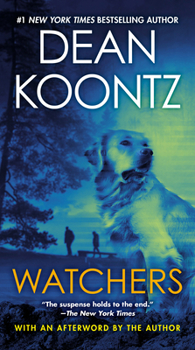
But, enter the genetically engineered killing machine loose in California and the government agency trying to cover it up.
This is one of Koontz’s most beloved novels. The movie, though, had a limited budget and only a 1.5-hour run time and not much of an emotional element. Instead, it was narrowed to being just a monster movie. Still a valuable watch (with a few eye rolls in between), but nowhere near the enduring test of literature as the novel.
The Book (1987): A Sci-fi Thriller that Dabbles in Horror
Travis Cornell is a former military operative with a secret, a secret Koontz doesn’t quite reveal in chapter one because before he can, or at least before you, the reader, think he is going to reveal it, in comes Einstein – a golden retriever sprinting as if being chased by the devil.
It’s Dean Koontz’s classic story structure to a T: throw your main character into terrible trouble and in every scene going forward have their predicament get subtly worse. Maybe a few wins in between but always one step forward, two steps back.
Travis doesn’t know it, but the dog does – the monstrous, grotesque, and intelligent Outsider is on the loose, and it’s after the dog, for they both are from the same lab and only one can win.
Einstein is an absolutely brilliant spin of the pen from Koontz. A dog with moods, ethics, humor, integrity, heart, and trauma. The Outsider has these qualities too, albeit far more beastly in execution. Both know what they are – genetically altered life forms that must live in the body and mind man made for them.
Watchers is a sci-fi thriller that dabbles in horror.
The Movie (1988): A Creature-Feature Monster-on-the-Loose Movie Starring Corey Haim.
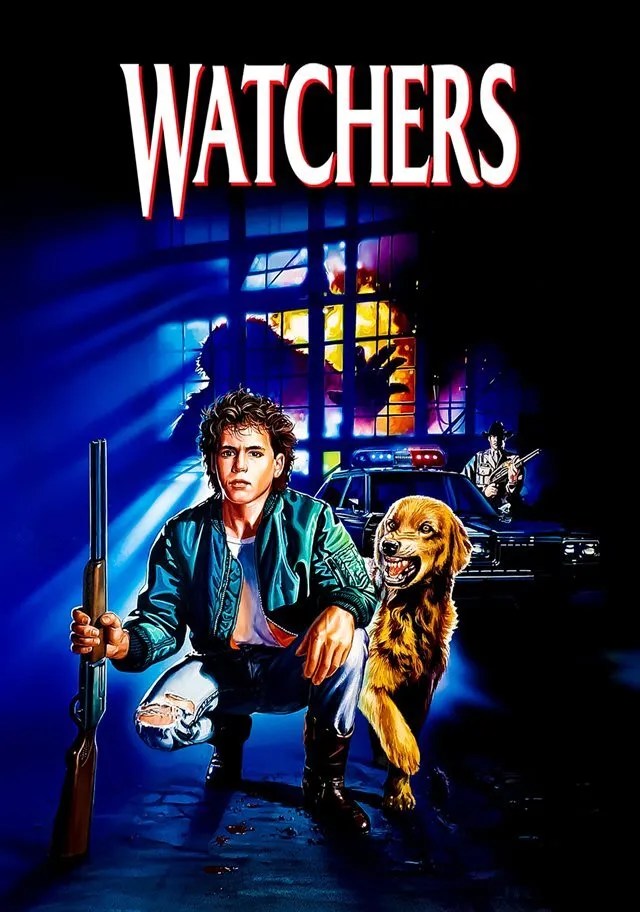
There isn’t much more to it than that. (My guess is Travis Cornell was aged down to make room for teen heartthrob Haim.)
While the novel was a slow burn, the movie compresses much of the emotional core into more on-screen body-horror situations and imagery. It plays out like a made-for-TV movie, where the scares are more anticipated.
The novel’s commitment to showing how humans and animals can survive trauma, guilt, and emotional damage is essentially wiped clean in the novel-to-movie translation.
The movie is worthwhile as a fun Friday night flick, but don’t expect a direct translation from book to screen or even an accurate portrayal of Koontz’s characters.
Expect an 80s monster movie with a dog.
If you enjoy the movie, there are three sequels, too.
Have you read Watchers, seen the movie, or both? Comment below.
You can reserve the book in the BCCLS system here.
You can watch the movie on Hoopla here.
Hit subscribe to get weekly updates on posts from the Hoboken Public Library!
Written by:
Sean Willey
Information and Digital Services Assistant