
Archive | Memoir RSS feed for this section

Stranger in the Woods (2017) by Michael Finkel

19 Mar

The Stranger in the Woods is the true account of Christopher Knight’s 27 year hermit journey in the Maine woods. No human contact, no conversation, no care for the outside world, just survival, and his own heartbeat against nature. He stole to survive, but took only what he needed. What’s remarkable about this book, besides its subject, is it achieves something consistent in its truth and a consistent question: Why?

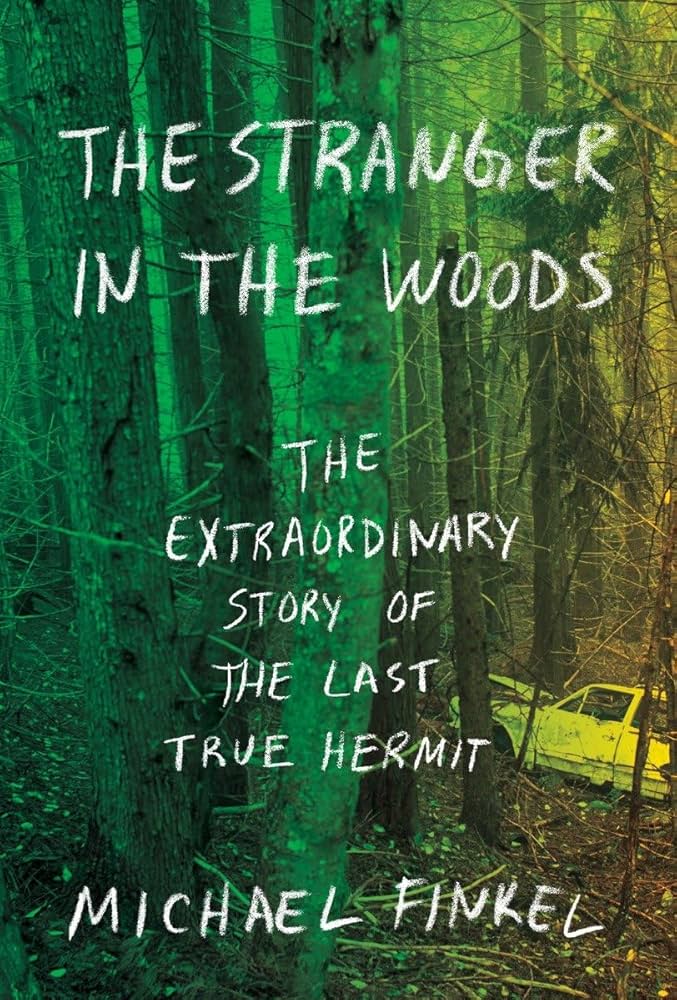
Book cover showing a dense and shadowy forest in tinted greens. Handwritten white chalk text reads “The Stranger in the Woods” and “The Extraordinary Story of the Last True Hermit.” In the background, a truck is hidden in the trees. The author's name, “Michael Finkel" is at the bottom.

Why do we need people and contact? Why do we succumb to society’s expectations? Why don’t we push harder to connect with universal truths? Why do we not pull away more from assumptions of who we should be. 

Knight’s story is not a sensationalized spew of intrigue, mystery, and crime, but an honest and connective account of someone who escaped authority and accountability for almost three decades. In a way, I came to respect Knight and his commitment to something he truly believed in, even if he knew it was wrong (if you think of it in terms of fiction, he’s a flawed antagonist, doing what he believes is right). 

What worked so well for me, is that Finkel lets the silence between Knight’s actions breath, giving us time to process both the magnificence of Finkel’s journey along with its mistakes. 

Finkel interviewed Knight extensively (though Knight was always reluctant and evasive), and he contextualizes Knight’s words with a blend of philosophy, psychology, and history. The book asks: Is solitude an illness, a spiritual awakening, a radical rejection, or just a preference?

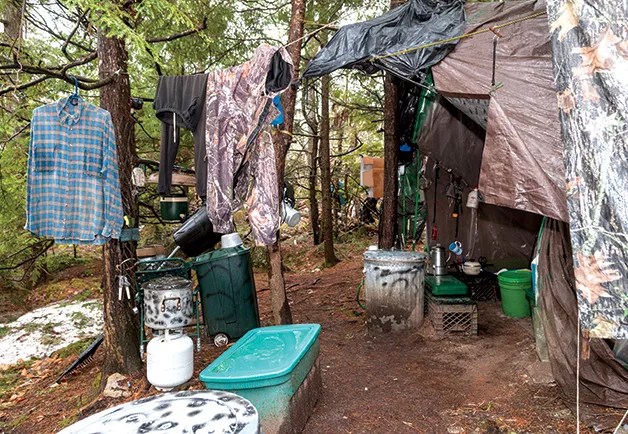
A makeshift campsite in a wooded forest. Tarps are strung between trees to form a shelter, with clothing hanging from lines. Buckets, plastic bins, a propane tank, pots, and other survival gear are scattered on the ground and tied to trees, showing Christopher Knight's living setup deep in the woods.

Above is a photo of Knight’s camp. I felt the weight of being alone with Knight throughout the book, and I sympathized with him. At a certain point, I perhaps even wanted to follow in his footsteps (just an interesting thing to think about). 

And why did my mind go there? Because Knight’s mind simply switched, as all of ours has at some point (even if to this extreme.) There was no traumatic event or dramatic falling out. He just walked into the forest.

There is a powerful detail Finkel shares in Knight’s memory that haunts and fascinates me: Knight never felt lonely in the woods and simply forgot what it felt like to need people.

Have you read The Stranger in the Woods? What did you think? Comment below.

If you haven’t read it, you can reserve it in the BCCLS system here. 

Hit subscribe to get more Hoboken Public Library Staff Picks delivered to your inbox!

Written by:
Sean Willey
Information and Digital Services Assistant

Meet Someone New! Read a Memoir: How to Say Babylon

3 Nov

On November 14, we are kicking off our new Memoir Book Club at the Grand Street Branch! Many people’s first foray into memoirs is through celebrity memoirs. We’ll read a few of these, but we’ll also choose titles that expand the definition of “memoir” and show us what’s possible in the genre. Memoirs in essays, auto-fiction, and hybrid memoir, alongside traditional memoirs such as our first pick, How to Say Babylon by Safia Sinclair.

How to Say Babylon
by Safia Sinclair
Sinclair is a poet, and the world she builds for us—her world—is rich, evocative, and breathtakingly vivid. It’s one thing to tell a story of your life, and another to take the reader by the hand and show them. Her memoir traces her journey from childhood to young adulthood, as she grapples with an oppressive childhood at the hands of her militant father and fights to break free. She contextualizes her story and that of her father through the lens of patriarchy, colonialism, and the history of the Rastafari movement. In my estimation, the best memoirs are meaningfully universal in their incisive specificity, and this one is no exception. Readers may also be moved by the role poetry played in helping Sinclair shape, change, and save her own life. If you enjoyed memoirs like Educated by Tara Westover, Memorial Drive by Natasha Trethewey, Men We Reaped by Jesmyn Ward, or Born a Crime by Trevor Noah, consider checking out How to Say Babylon. Published in 2023, How to Say Babylon was considered a best book of the year by The New York Times, The Washington Post, Goodreads, NPR, Barack Obama and more, and was a Read with Jenna Book Club Pick. 

You can borrow How to Say Babylon from BCCLS in print, large print, eBook (from elibraryNJ and eBCCLS), and audiobook formats. Please reach out to grandstreet@hobokenlibrary.org if you have any questions or would like us to place a copy aside for you to pick up! Hope to see you on November 14th for the discussion.

Written by:
Ally Blumenfeld
Grand Street Branch Manager