Tag Archives: stephen king

September Horror Book Club Pick: Cujo by Stephen King (1981)

12 Nov

Cujo tears into me with a horror that legitimately makes me sick to my stomach, and, honestly, I like it. King does not remember writing Cujo, due to his demons with addiction (you can Google the specifics), and I have a theory – perhaps Cujo is his written subtextual and reticent cry for help.
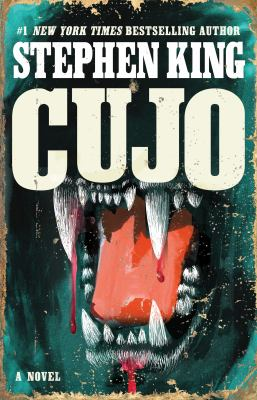
Illustrated book cover of Cujo by Stephen King, featuring a close-up of a snarling dog's mouth with sharp teeth and dripping blood against a teal background.

He (Cujo) was a good dog until the nipping, pinching bat’s bite comes and, day by day, eats at the Saint Bernard’s central nervous system and turns him into a bloodthirsty beast hell-bent on attacking anything to satiate his pandering indulgence. The vicious disease consumes Cujo until he’s nothing but mangled fur, bloody eyes, foaming snot, and a poor dog intensely overstimulated and angered by his haywire sight, hearing, and idea of who he was.

That’s the strength of this novel for me. Cujo knows he’s a good boy, a dog who would do anything to protect “The man, The woman and The boy” (his owners), and he tries so hard not to bite, but the disease has fully consumed him. Family, a home, and a purpose (to be a good, playful, and protective companion) exist no more, and he is at the mercy of his corroding body and neurodegenerative erosion.

“Cujo used to be a big friendly dog, lovable and loyal to his trinity (The Man, The Woman, and The Boy) and everyone around him, and always did his best to not be a BAD DOG. But that all ends on the day this nearly two-hundred-pound Saint Bernard makes the mistake of chasing a rabbit into a hidden underground cave, setting off a tragic chain of events. Now Cujo is no longer himself as a growing sickness slowly overcomes him, one that consumes his mind even as his once affable thoughts turn uncontrollably and inexorably to hatred and murder.” – from the BCCLS catalog

Cujo is a masterclass in animal and psychological horror that is an early hallmark in King’s “what if” structure – what if a mother and son are stuck in a car and a rabid dog is stalking them? What if a dog is defenseless (no vaccine) to a terrible disease?

It’s a horror that could reach into all of us, and once a virus latches on, it’s up to us to fight it. How can we find a way to survive? But what if we can’t?

Cujo comes in at just under 400 pages. The audiobook is also extremely well done. The story haunts me the most of any King novel because of how it’s grounded in the irrationality of an evil that very well could consume others walking among us every day. When a poison has you by the throat, what defense to rationality and logic have against brute insanity and hunger?

Cujo is available in the BCCLS catalog here. The audiobook is on Hoopla here and the Ebook on Hoopla here.

Once you’ve had a read or listen, grab the movie in the BCCLS catalog here.
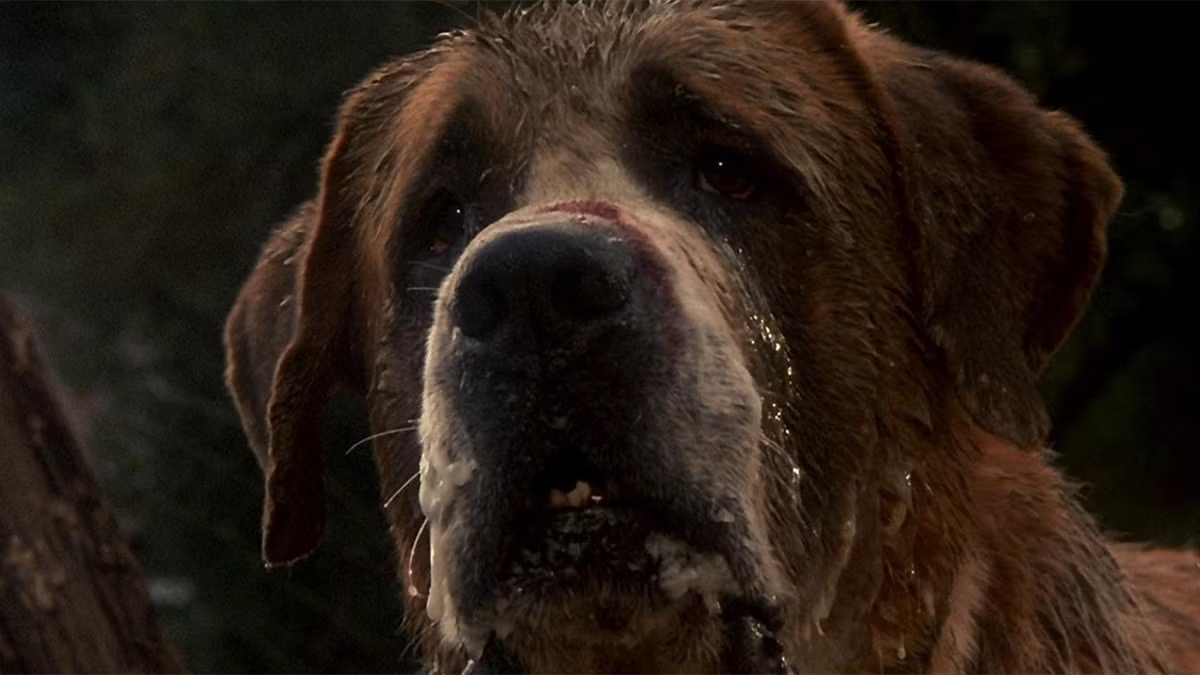
A close-up of a large, distressed St. Bernard dog (From the 1983 movie, Cujo) with matted, wet brown and white fur, looking upward with sad eyes. Thick white foam and saliva drip heavily from its open jowls and snout.

Rattlesnakes, the novella sequel, is available in You Like it Darker by Stephen King (2024). 

Cujo was September’s Horror/Thriller Book Club pick. If you are interested in joining, you can email reference@hobokenlibrary.org

Hit subscribe to get weekly updates on posts from the Hoboken Public Library!

Written by:
Sean Willey
Information and Digital Services Assistant
Movie Review: Children of the Corn (1984)

11 Jun

How this movie/Stephen King turned driving through a cornfield (a pretty boring experience, trust me, as a Midwesterner) into one of the most horrifyingly claustrophobic and isolated cult rituals I have ever seen is brilliant. 

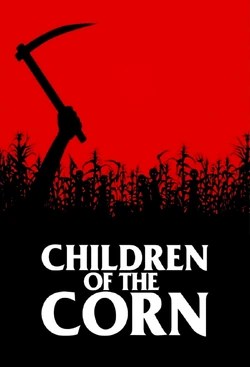
Movie poster for Children of the Corn, 1984. A silhouetted hand raises a sickle against a blood-red sky above a dark cornfield. The title "Children of the Corn" appears in bold white text at the bottom.

I discovered the movie while researching comparable titles to my own next novel. I always knew it existed but, for some reason, it never quite appealed to me, until I learned it was based on a Stephen King short story. That pushed me over the edge. 

What makes Children of the Corn classic horror is its roots in the fear of sensory deprivation.

Burt and Vicky are driving through Nebraska when they accidentally hit a child. They swear he came straight out of nowhere. And when there are miles and miles of tall, sun-bleached, waving corn blowing in the wind, there is simply no way to tell what’s hiding inside of it. That image,  simple as it sounds, is the beating heart of this film.

The two scramble with how to deal with this, and the further they go into the endlessness of the roads ahead, the more they find themselves circling nothing but corn, decimated storefronts, and evasive, guarded residents. This leads them to the ghost town of Gatlin. 

But that’s just what the surface shows.

Underneath, a twisted cult-preacher boy named Isaac and his second-in-command, Malachai, run the town. No adults remain. He Who Walks Behind the Rows commanded the children to slaughter every one of them.

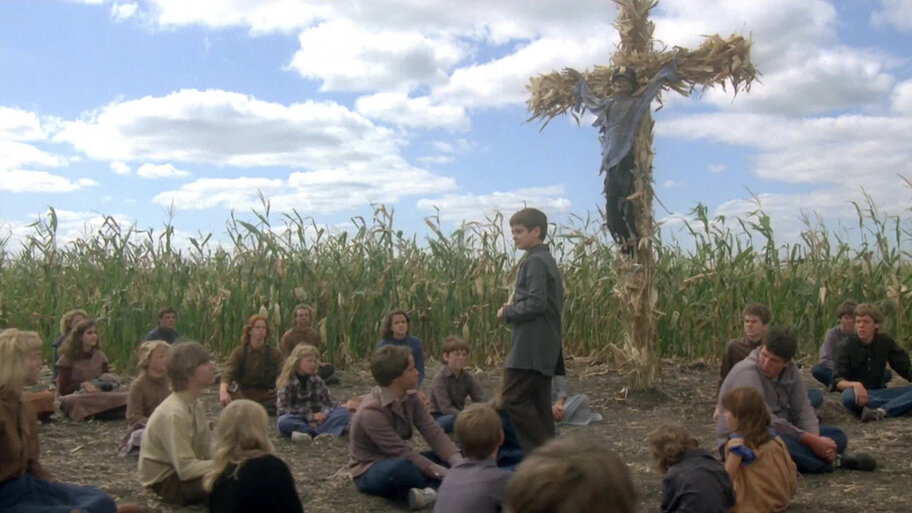
A scene from Children of the Corn. A group of children sit in a circle at the edge of a cornfield. A boy stands at the center. Behind him is a police officers skeleton perched as a scarecrow attached to a tall wooden cross made of dried corn stalks.

Thus, Burt and Vicky’s crime is a simple one: being adults in the wrong place at the terribly wrong time.

One of King’s early literary inspirations was William Golding’s Lord of the Flies, and it shows here. Children of the Corn is about the terrifying idea of a world without rules, without adults, without the structures we’ve grown complacent to. It takes one of the most ordinary and mundane American settings, a small town where a stranger would expect a friendly hello, a polite wave, and easy hospitality, and makes everything in it disturbing and petrifying.

The corn breathes alongside them, growing more unsettling with every scene.

I won’t go into the rich undercurrents of fundamentalism, cult and folk ritual, or the movie’s representation of self-imposed malicious parentification. 

The movie created such a powerful dread that it spurred a new archetype for the genre: The Children of the Corn Dynamic – youth-led groups or cults that completely overthrow and control the adult population (King, 1978; TV Tropes).

P.S. Do not confuse this with the 2023 remake/reboot. The original is much more worth your time!

Reserve your DVD copy in the BCCLS system here.

Bluray here.

Or, read the short story published in 1977 on Overdrive/Libby.

Comment below your thoughts once you’ve had a watch.

Hit subscribe to get weekly updates on posts from the Hoboken Public Library!

Written by:
Sean Willey
Information and Digital Services Assistant