Archive | DVDs RSS feed for this section

TV Review: BBC’s The Hitchhiker’s Guide to the Galaxy (1981)

23 Jun

It’s completely absurd, and yet I was completely along for the ride. I hand it to the British who go about their comedy without warning or apology. Take it or leave it, but The Hitchhiker’s Guide to the Galaxy British humor and societal commentary at its best.

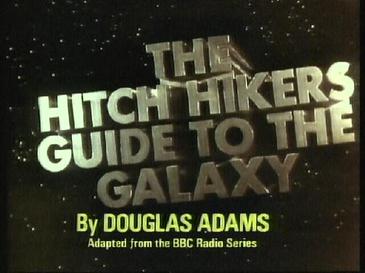
The title credits from the 1981 BBC miniseries reading "The Hitch Hikers Guide to the Galaxy by Douglas Adams — Adapted from the BBC Radio Series," displayed in metallic lettering against a starfield background.

In a way, it’s that absurdity, that choice to disregard the logical in favor of a radical representation of what life would be like if humans were completely annihilated. One though, Arthur Dent, is lucky enough to come face-to-face with the terms of the galaxy’s bureaucratic existence and its role in the inconvenience of life, the universe, and everything.

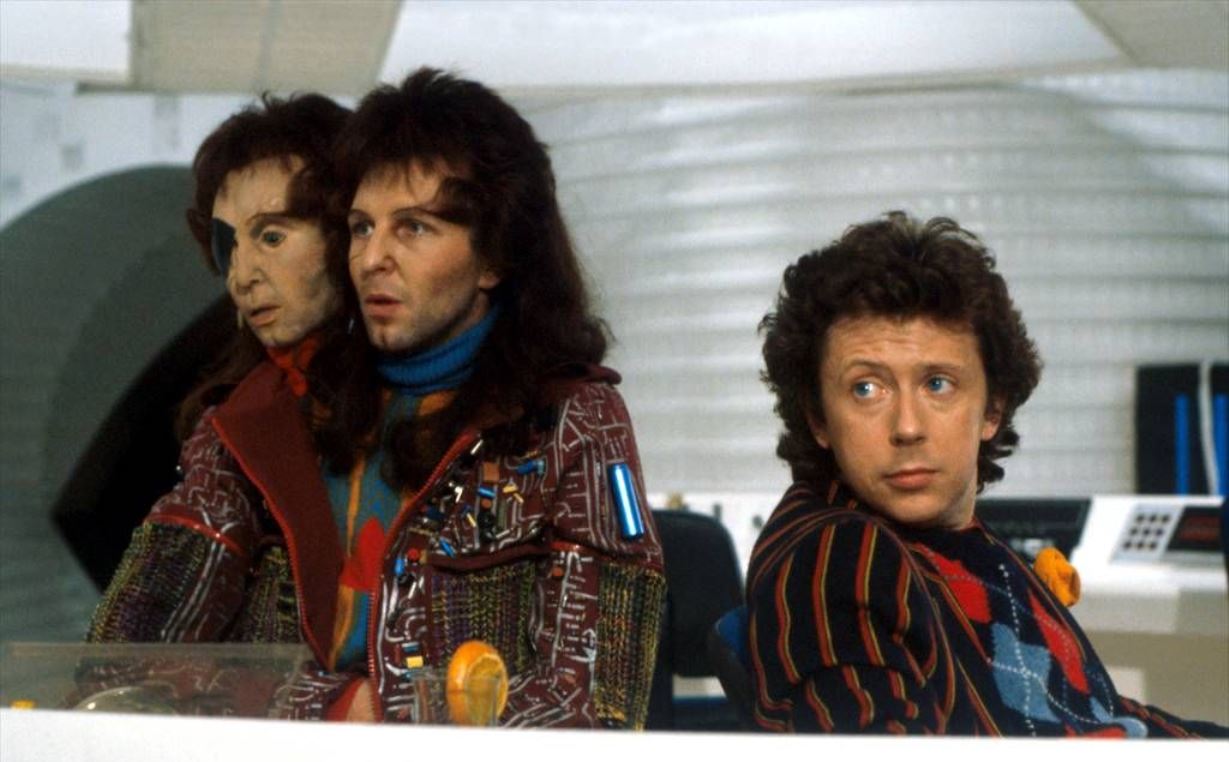
A still from the 1981 BBC miniseries showing Zaphod Beeblebrox with his prosthetic second head visible over his left shoulder, seated next to Arthur Dent in the cockpit of their spaceship. Both are wearing colorful, eclectic 1980s sci-fi costuming.

We begin with Arthur’s house about to be demolished for a bypass. But so is Earth. Thankfully, his friend, Ford Prefect, is an undercover researcher for the next edition of the intergalactic travel guide, The Hitchhiker’s Guide to the Galaxy. Ford finds a way to get them off Earth seconds before the Vogons, the universe’s most bureaucratic species, reduce it to rubble.

The Vogons don’t destroy Earth because they’re bad, but because the paperwork was filed on time and no one from Earth objected to the plans on display millions of miles away. It’s quite a commentary.

It’s six episodes of traveling in a bathrobe, stolen starships, a two-headed President of the Galaxy, a depressed robot named Marvin, whose vast intelligence makes him paranoid and depressed, and the search for the answer to the question of life.

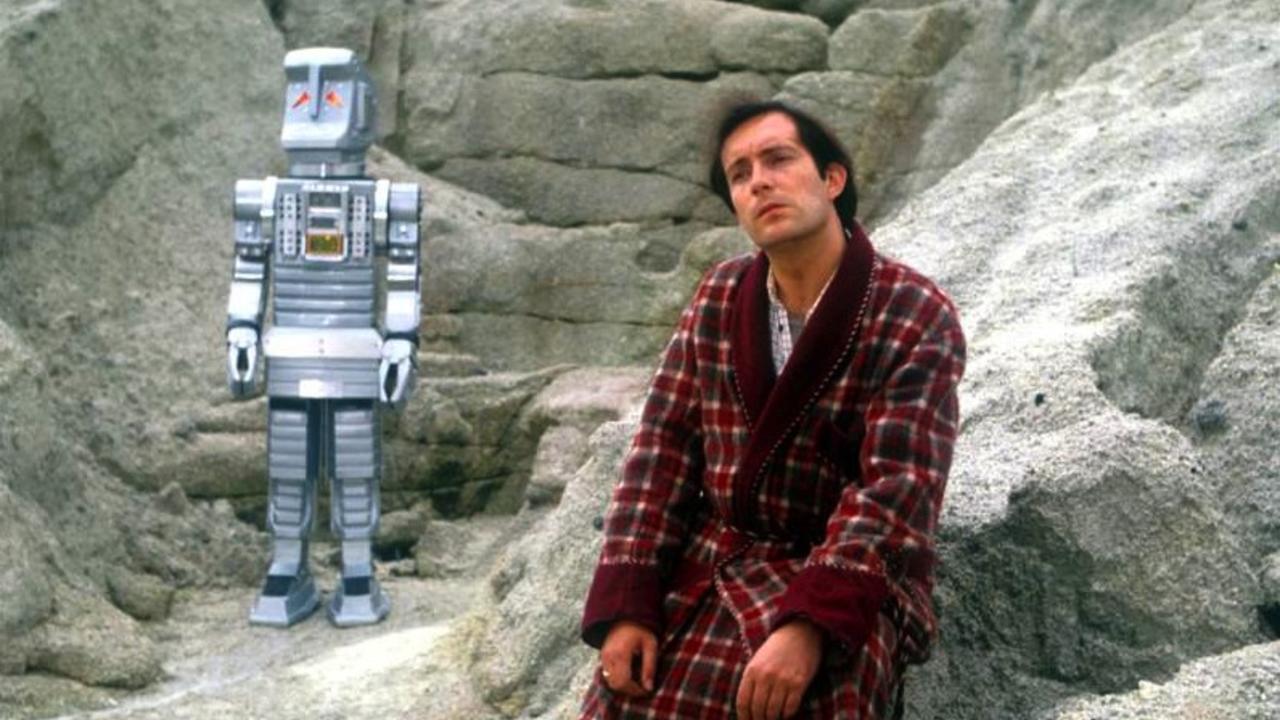
A personal shoutout to Marvin – the paranoid robot engineered with Genuine People Personalities who loathes his existence and feels everyone should be as miserable as him. Depending on the day, he is completely relatable.

Arthur Dent, wearing a plaid bathrobe, sits on a rock beside Marvin the Paranoid Android — a boxy, silver robot standing to his left. Both look off into the distance.

Yes, this is 1981 BBC. Expect effects and props built solely from imagination. Although I quite enjoyed the old computer graphic overlays used throughout.

As the Guide tells us on its front cover, Don’t Panic. Sit back and enjoy the journey into one of Britain’s greatest comedic outputs (and cult followings).

P.S. The 2005 film staring Martin Freeman, Mos Def, Zooey Deschanel, and Alan Rickman as the voice of Marvin, does not disappoint either, but I recommend watching the TV series so you get the full scope of Douglas Adam’s created universe and farcical renderings of authority and management.

The TV series is available on Kanopy here. (Free with your Hoboken Public card).

DVD in the BCCLS system here.

Bluray in the BCCLS system here.

Interested in the book? Reserve it in the BCCLS system here or borrow as a digital audiobook here.

Comment below your thoughts once you’ve had a watch.

Hit subscribe to get weekly updates on posts from the Hoboken Public Library!

Written by:
Sean Willey
Information and Digital Services Assistant
Movie Review: Children of the Corn (1984)

11 Jun

How this movie/Stephen King turned driving through a cornfield (a pretty boring experience, trust me, as a Midwesterner) into one of the most horrifyingly claustrophobic and isolated cult rituals I have ever seen is brilliant. 

Movie poster for Children of the Corn, 1984. A silhouetted hand raises a sickle against a blood-red sky above a dark cornfield. The title "Children of the Corn" appears in bold white text at the bottom.

I discovered the movie while researching comparable titles to my own next novel. I always knew it existed but, for some reason, it never quite appealed to me, until I learned it was based on a Stephen King short story. That pushed me over the edge. 

What makes Children of the Corn classic horror is its roots in the fear of sensory deprivation.

Burt and Vicky are driving through Nebraska when they accidentally hit a child. They swear he came straight out of nowhere. And when there are miles and miles of tall, sun-bleached, waving corn blowing in the wind, there is simply no way to tell what’s hiding inside of it. That image,  simple as it sounds, is the beating heart of this film.

The two scramble with how to deal with this, and the further they go into the endlessness of the roads ahead, the more they find themselves circling nothing but corn, decimated storefronts, and evasive, guarded residents. This leads them to the ghost town of Gatlin. 

But that’s just what the surface shows.

Underneath, a twisted cult-preacher boy named Isaac and his second-in-command, Malachai, run the town. No adults remain. He Who Walks Behind the Rows commanded the children to slaughter every one of them.

A scene from Children of the Corn. A group of children sit in a circle at the edge of a cornfield. A boy stands at the center. Behind him is a police officers skeleton perched as a scarecrow attached to a tall wooden cross made of dried corn stalks.

Thus, Burt and Vicky’s crime is a simple one: being adults in the wrong place at the terribly wrong time.

One of King’s early literary inspirations was William Golding’s Lord of the Flies, and it shows here. Children of the Corn is about the terrifying idea of a world without rules, without adults, without the structures we’ve grown complacent to. It takes one of the most ordinary and mundane American settings, a small town where a stranger would expect a friendly hello, a polite wave, and easy hospitality, and makes everything in it disturbing and petrifying.

The corn breathes alongside them, growing more unsettling with every scene.

I won’t go into the rich undercurrents of fundamentalism, cult and folk ritual, or the movie’s representation of self-imposed malicious parentification. 

The movie created such a powerful dread that it spurred a new archetype for the genre: The Children of the Corn Dynamic – youth-led groups or cults that completely overthrow and control the adult population (King, 1978; TV Tropes).

P.S. Do not confuse this with the 2023 remake/reboot. The original is much more worth your time!

Reserve your DVD copy in the BCCLS system here.

Bluray here.

Or, read the short story published in 1977 on Overdrive/Libby.

Comment below your thoughts once you’ve had a watch.

Hit subscribe to get weekly updates on posts from the Hoboken Public Library!

Written by:
Sean Willey
Information and Digital Services Assistant