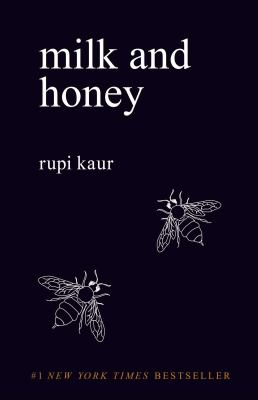
I had written about one of New York Times bestsellers “Milk and Honey” by Rupi Kaur, as poetry that is an outstanding understatement. Now, for National Poetry Month, I second that opinion with this next poem from that same chapter “the loving”.
“i do not want to have you night / to fill the empty parts of me / i want to be full on my own / i want to be so complete / i could light a whole city / and then / i want to have you / cause the two of us combined / could set it on fire”
As I’ve said before, “Milk and Honey” is not only a collection of poetry and prose about survival, it’s also a love song. This book calls to everyone, with its four chapters labeled, “the hurting”, “the loving”, “the breaking”, and “the healing”. During these times I find myself in the chapter “the loving”, specifically this poem.
Just as the poems have no titles, we have no name for this time we are all experiencing. This can be seen as an editing choice or a purposeful choice that is supposed to signify unity. Alluding to my idea, we see this from the chapter “the loving”. The last two lines of said poem can be found on page 59 and it reads:
“cause the two of us combined / could set it on fire”
We are all in a time that we are all in. Everyone is experiencing suffering, pain, hurt, loss, and depravity, but we are all experiencing it together. In a time where some of us may be feeling lonely during isolation, let this poem remind you that you are not alone. This is a time for everyone, for you, to become great and to love yourself, so when we finally get together once again, we will light up the whole world.
Of course this is just my own emotional connection to this particular prose, as there are other particular depths within me that it reaches also. But as a whole this speaks to a deeper and somewhat neglected part of myself that calls to light how I see, treat, and care for myself emotionally, physically and spiritually.
Now is the time to love ourselves, to love one another, and feed into our neglected souls so when the isolation is lifted and we are ready to come back out, we set the world glowing with unity.
For more on poetry, please feel free to visit our Facebook and YouTube for some cool videos and our website for ways on how you can read online through our apps. You can try writing some of your own with our Friday Writing Prompt featured below.
Written by
Sherissa Salas
Adult Programming Assistant/Media Liaison
Friday Writing Prompt:
Poetry can be intimidating since we do not encounter it as frequently on a daily basis as many types of writing, however, April being Poetry Month, it is the perfect time to dive in and give it a try, even if you never have before. The best way to get a feel for poetry is by reading other poet’s works. You can check out a variety of poetry collections including Kaur’s Milk and Honey on Hoopla.
Take inspiration from the beautiful lines of Kaur’s poem that Sherissa shared and think of how your own loneliness makes you feel. What about it do you enjoy and what do you dislike? What imagery or objects do you associate with it, that you could use in your poem? What person have you not been able to see in the last few days, whom you miss, is the first you would like to see again? How will you feel when you see them? What will the experience be like? Is there a specific imagery or object you associate with being together with them you could use in your poem? Now get writing! And if you like your poem consider sharing it with the person you were inspired by.
Have a favorite poet? Share in our comment section!
Written by:
Aimee Harris
Head of Reference
Tags: Rupi Kaur


 Hoboken Public Library Blog