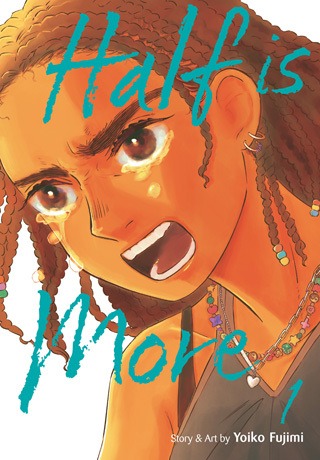
The manga Half is More (Vol. 1) — with new English translations by David Evelyn — is a noteworthy attempt to shed light on the realities of living in Japan as hafu, or people that have a Japanese parent and a non-Japanese parent. Written by Yoiko Fujimi, herself a half-Spanish and half-Japanese woman, Half is More goes beyond its racial context and explores what it means to belong in a world that ignores the nuances and color of an ever-changing society in the 21st century.
In the first chapter, we meet Kazumi and her brother Yuta at a Starbucks. Yuta tells Kazumi that he dropped their French dad’s surname from his government name in order to be as “normal” as possible, something that Kazumi would never understand because of her resiliency. Kazumi spirals. Of all people, her brother was supposed to be the one that understood her everyday struggles as a hafu. Defeated, Kazumi struggles to be more vulnerable with her best friend to share about all her experiences and allow her best friend to hold that — despite the differences in their own lived experiences.
I liked the way that Fujimi builds this realistic world of interconnected female characters that explore their own struggles of belonging and healing. As each chapter progresses, we learn more about existing characters through new ones that are somehow related to each other. Fujimi’s purposefulness to employ different POVs per chapter when there are already-existing characters or stories that overlap with each other creates layers of texture to a story that could otherwise feel one-dimensional.
The choice to platform the lived experiences of hafu is also very fresh, given the landscape of stories that manga authors and publishers choose to tell. From the manga that I have encountered, it is incorrectly assumed that the characters are Japanese due to the absence of racial indicators. If there are hafu characters, they are usually minor characters or portrayed in a stereotypical or flat way. What Fujimi decides to illustrate are everyday Japanese women from various racial and ethnic backgrounds navigating realistic situations like migration, family separation, identity, and rectification. My one critique is that there is only so much that an author can expand on in one volume with changing POVs every chapter, but I would love to see how the subsequent volumes overcome that challenge and employ new storytelling devices.
While I have never lived in Japan, I did resonate with the larger themes of misunderstanding and belonging as someone who has struggled with connecting with people throughout my life. I am still learning to find ways to connect in the way that is considered the societal norm and am working to clearly express how I am feeling or avoid any misunderstandings. There are small breakthroughs, but these are lifelong challenges that I will continue to work on and overcome bit by bit — and painful growth through perseverance is universal. Our identities, struggles, and lived experiences are made up of many changing parts, and Half is More drives home that everyone is a whole person, despite how society chooses to perceive us. That gives me hope and courage to continue forward, and I am excited to see how the series progresses in the next volume.
Written by:
Laura Austria
Information and Digital Services Assistant


Leave a Reply