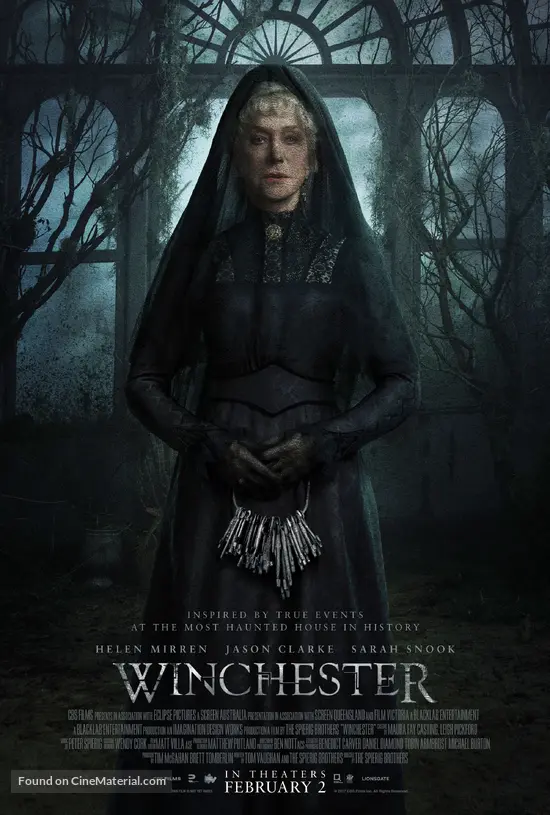
Gun heiress Sarah Winchester (Helen Mirren) builds a 7-story mansion. Staircases lead to nowhere, and 100’s of rooms open to only walls. Honestly, I thought this was an exaggerated historical fiction account, but no, this is a inspired by true story.
The house in San Jose, California, is still standing and open for tours, and many consider it the most haunted residential house in the United States.
Sarah Winchester, widow of William Winchester and heiress to the Winchester fortune, demanded and ordered this house be built around the clock, but workers were given no master plan.
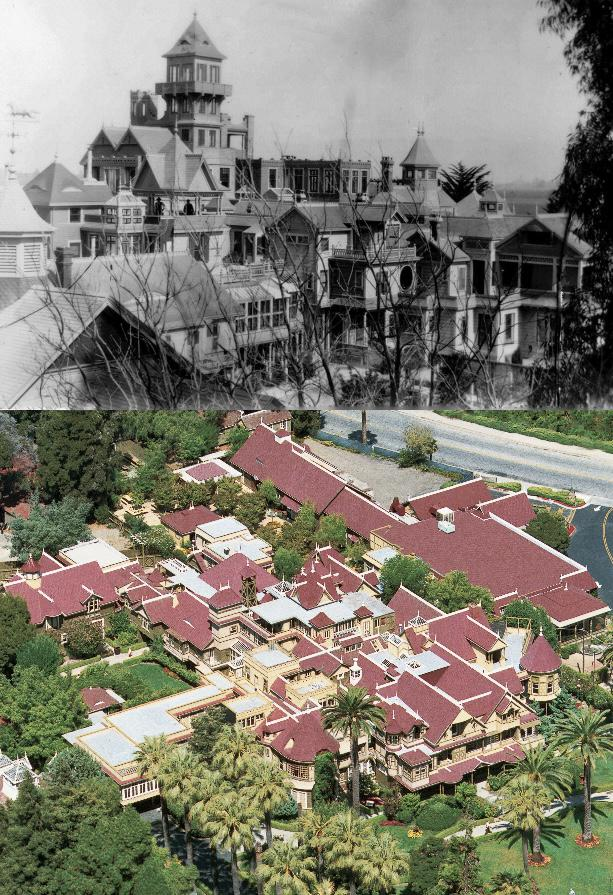
The house was a 38-year construction project started in 1866 and had a total of 160 rooms winding 7 floors until a 7.8 magnitude earthquake leveled the house to it’s current four stories (top picture).
Today (bottom), though, the structure is still a labyrinth of hallways, 40 bedrooms, six kitchens, 2,000 doors, 10,000 window panes, and 47 fireplaces with only 17 chimneys. Doors really do lead straight into walls and windows are on the floor. One in the séance room opens up to nothing but an eight-foot drop directly to a sink.
Why would someone want a house with over a hundred rooms, staircases leading to ceilings, doors that open to drops, and staircases that wind in maze-like fashion?
Sarah is convinced she’s cursed by the sins of her fortune, so all this is meant to ward off the spirits killed by her family’s product.
If she can build a house so confusing, perhaps it will confuse them and keep them contained.
In 1906, the company’s board sends Dr. Eric Price (Jason Clarke), a drug-dependent psychiatrist, to declare her unfit to run the business. This is not a mission of goodwill on the board’s part. Instead, Dr. Price starts seeing these ghosts in gruesome fashion.
Is it the drugs or the actual suspicions of Sarah manifesting?
Mirren, as always, is committed to her role and takes a script that seems to want to be a bit too jump scary back to the true story’s more gothic and macabre roots. The house, too, is a character in itself, and the movie leans hard into its confusing architecture.
I must be honest: if it wasn’t for these two stars, the story would simply be another jump-scare, stereotypical ghost-with-a-grudge story. The beats (while I admit I still jumped) can be obvious, especially for a vetted haunted house movie watcher. However, if you, the viewer, tap into the guilt and grief behind the moral and repercussive pain of Sarah Winchester, then it’s quite a lovely gothic homage to the moral message of the monuments, big and small, each of us has built for the ones hurt (even if indirectly) by our doings.
This is where I have to be honest: the ghosts are pretty predictable. Jump scares, a vengeful spirit with a grudge, etc. Fans of haunted-house movies will see many of these coming. But, there’s a much stranger, sadder movie underneath about guilt, grief, and a woman literally building a monument to everyone her husband’s business ever hurt.
Winchester is a good scary-night movie, helped by the fact that sometimes history is scarier than fiction.
Reserve the Bluray in the BCCLS system here or the DVD in the BCCLS system here.
Comment below your thoughts once you’ve had a watch.
Hit subscribe to get weekly updates on posts from the Hoboken Public Library!
Written by:
Sean Willey
Information and Digital Services Assistant