Staff Picks for Poetry Month – Part 1

15 Apr

How to Read a Poem…and Start a Poetry Circle by Molly Peacock
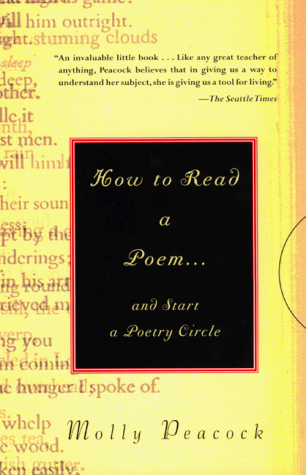
how to read a poem

Do you have doubts about your ability to read and understand poems? Do you nonetheless long to have poetry be a part of your life? If so, Molly Peacock’s How to Read a Poem…and Start a Poetry Circle may be the reading companion you’ve been looking for.

Part memoir, part reading guide, How to Read a Poem is a lyrical, personal exploration of the power and nuance of poetry. Peacock shares her own love of the art, describing how her favorite poems not only speak to her, but often speak for her, articulating aspects of her inner life that she herself had never found words for. This is true, she admits, even of poems she finds hard to fully comprehend. In other words, sometimes our bodies intuit the meaning and relevance of certain poems before our minds manage to decode them.

To help readers in our own deciphering of poems, Peacock invites us to think about poetry as a fusion of music, storytelling, and painting, with the line forming the music, the sentence telling the story, and the image showing us the poet’s vision.

She describes her joy not only in reading poetry for and by herself, but in sharing poems with friends who share her passion for the form. She tells of intimate gatherings where she and her companions each bring out a favorite poem—their talismans Peacock calls them since she carries beloved poems with her like charms—to read aloud over a meal. Whether two friends participate or many more, this reading to one another constitutes what Peacock calls a poetry circle. She states simply, “A poetry circle occurs when the mutual reading of poetry is at hand.”

Finally she offers an anthology of her talismans, with personal stories and startling insights to go with each poem. Thus, by reading Molly Peacock’s love treatise to poetry we become a part of her inner circle of poetry friends.

Immersed in Verse: an Informative, Slightly Irreverent and Totally Tremendous Guide to Living the Poet’s Life by Allan Wolf

Immersed47K

Immersed in Verse is a guide for teens interested in reading poetry, writing poetry and generally living like a poet. While the book’s style is playful and inviting, the advice within is serious and sound, making it a great introduction to poetry for beginning writers of any age.

Wolf summons readers to “plunge into words”, to notice with all our senses how the world we live in touches and affects us. “Poems,” Wolf tells us, “are all around us waiting to be written.” He defines poetry as a communication of what’s inside us and invites readers to write about the things that catch our attention, burst into our minds, or live in our hearts. His enthusiasm for looking at the world as a poet does, fully awake, is inspiring and contagious.

Wolf then offers a ‘guided tour’ of the various types of poems—rhyming, free verse, sad poems, funny poems, teaching poems, apologizing poems, love poems, hate poems, dialogues, riddles and more. “By opening up the possibilities of what a poem can be,” he tells us, “you discover a diverse buffet.”

We learn the nine habits of highly successful poets, including doing more and watching less, writing every day, and being playful with words. Wolf also gives quick digestible lessons on metaphor, simile, personification, meter, rhythm, repetition and internal and external rhyme. He offers assignments and prompts to inspire writers and help us jumpstart their poems. Finally, Wolf provides tips for performing poetry, hosting a poetry bash, making our own poetry books and seeking publication.

Immersed in Verse is a fun and thorough introduction not only to writing poetry but to choosing poetry as a way of life.

– Ona Gritz, Young Adult Librarian

 Click on the picture of either book to reserve a copy for yourself!

how to read a poem Immersed47K

Number 42 for Kids

10 Apr

jackierobinson

This week, a new movie will hit the theaters highlighting the life and career of Jackie Robinson, number 42 on the Brooklyn Dodgers.  Robinson, the first African American to play major league baseball, played until 1957, but it is his very early years that are most noteworthy.  The story of Jackie Robinson is one of perseverance and bravery, but it is also the story of the men who enabled Robinson to become a pioneer in baseball.  Branch Rickey, the President of the Dodgers, could have picked the potentially more talented Josh Gibson or Satchell Paige to be the first Black player.  However, he counseled Robinson that he would need fortitude to ignore the taunts and abuse that he would undoubtedly receive from the stands.  Among Robinson’s supporters was Hank Greenberg, a Jewish player who understood the mistreatment Robinson would receive, and the Southern-born Pee Wee Reese, an unlikely booster, but a friend to Jackie for life.

There have been many children’s book written about Jackie Robinson and his career, but perhaps more importantly was the impact of the man on people that post-War America considered “outsiders.”  The following books are both biographical tributes to Number 42 and books that fictionalize how young people viewed this heroic man who earned his place in sports’ history by standing strong. To reserve a copy of any of these books, just click on the book title and you will be taken directly to the library’s catalog 🙂

In the Year of the Boar and Jackie Robinson

In the Year of the Boar and Jackie Robinson, by Bette Bao Lord is the story of a young Chinese girl who owes her Americanization both to baseball, her ability to play stickball (the street version of baseball, but you have to be from a particular kind of neighborhood to know the rules), and to her devotion to her hero, Jackie Robinson.

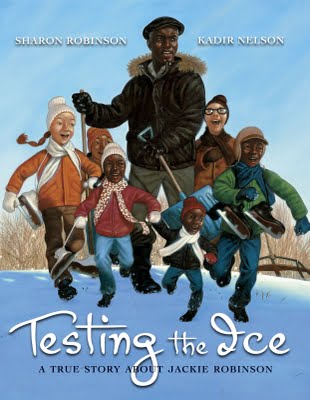
TestingTheIceCover

Testing the Ice, by Sharon Robinson and Kadir Nelson, is a personal story, told by Jackie Robinson’s daughter, about how her seemingly fearless father had one very real fear.  He was afraid of water, having never learned to spring.  On a winter’s day, he finally challenges his own apprehensions by walking to the center of a frozen pond illustrating for his daughter the courage that made the man.

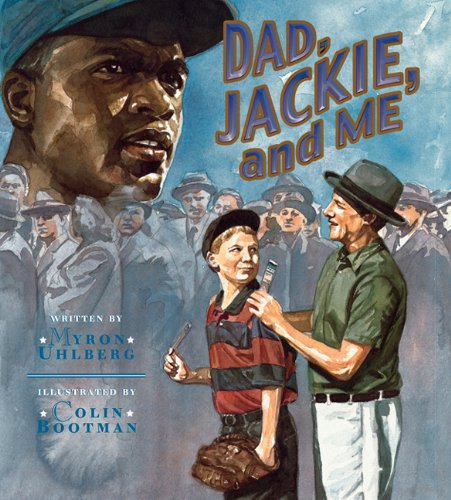
DadJackieAndMe

Dad, Jackie and Me, by Myron Uhlberg and illustrated by Colin Bootman, shows how important Robinson’s success was to all outsiders.  In 1947, Uhlberg would go to Dodgers’ games with his hearing impaired father.  While his father did not understand the game, he clearly understood the hatred being aimed at Robinson when he went on the field.  It was Robinson who inspired Uhlberg’s father to learn about the national past time and also talks about little known “Dummy” Hoy, a hearing impaired player who played for fourteen years in the major leagues.

when-jackie-and-hank-met

When Jackie and Hank Met, by Cathy Goldberg Fishman with illustrations by Mark Elliot, is the fleshed out story of the brief collision on the field between Jewish player Hank Greenberg and Jackie Robinson, and how Greenberg’s encouraging words forged a lifelong friendship.

0316340944

Snow in August, by Pete Hamill, is one of my all-time favorite books.  It is for older readers and adults.  I would comfortable give it to a good reader of 12 years through adult.  It is a coming-of-age story in much the same way that A Tree Grows in Brooklyn is.  After World War II, Rabbi Hirsch, a concentration camp survivor, moves to Brooklyn and opens a small synagogue.  He turns to a young neighborhood boy, Michael Devlin, to do small chores for him that cannot be performed by a religious Jew on the Sabbath. As Michael and the Rabbi become friends, they bond over baseball and Jackie Robinson.  Both admire Robinson’s ability to stand up to bullies, much like the bullies who terrorize their Brooklyn neighborhood.  When the neighborhood toughs break into the synagogue looking for what they think is a treasure of Jewish gold, Michael digs into Jewish mythology and creates a golem, a giant creature charged with protecting Jews against anti-Semites. The post-war atmosphere and the need for a superhero to fight against discrimination plays in well to the story of Jackie Robinson, and will gently teach young readers how hatred festers when good men do nothing.  A truly memorable book.

With the baseball season now in full swing, these and other books about Robinson, the Negro Leagues, the All-American Girls Baseball League, among other heroes, will show young readers an entirely different side of a sport we consider uniquely American.

– Lois Rubin Gross, Senior Children’s Librarian