Gone Girl and Lost Girls: Two Tales of Six Girls

1 Sep

I recently realized that two books I read this summer were from different genres but similar as they were both about missing women: Gone Girl by Gillian Flynn (fiction) and Lost Girls: An Unsolved American Mystery by Robert Kolker (nonfiction).

***

You may have already heard of Gone Girl. This popular thriller by Gillian Flynn topped many best-of lists last year. I happened upon a copy while shelving and grabbed it since it’s been so popular. Reese Witherspoon’s production company is adapting the story into a movie starring Ben Affleck and Rosamund Pike.

gone-girl

The Girl that’s Gone is Amy Elliott Dunne, who mysteriously disappears from her home the morning of her fifth wedding anniversary. This book has two alternating narrators–her husband Nick and Amy, via journal entries, which I think is an interesting device. Which narrator should the reader trust? Who is telling the truth?

After Nick and Amy lost their jobs during the recession, they moved from Brooklyn to Nick’s hometown of North Carthage, Missouri. Their relationship becomes strained as Amy, a native New Yorker, is a fish out of water in the Midwest while Nick easily assimilates.

Nick is the main suspect after Amy goes missing, which rocks the small town and immediately becomes a national news. Nick maintains his innocence despite everyone’s suspicions–his only ally is his twin sister Margo–and works to find other suspects in Amy’s disappearance. Will Nick clear his name? What happened to Amy?

***

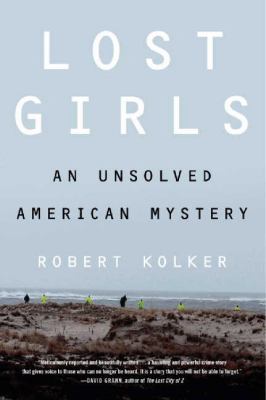
Lost Girls is an impeccably reported true crime story about the disappearances of five women that worked as escorts. I read an interview with Kolker on Gawker, and was intrigued by this book.
lost-girls

The book begins with Shannan Gilbert’s disappearance from a home in Oak Beach, a secluded community on the south shore of Long Island. The local police force’s reluctant search for her eventually led to the discovery of four other women believed to be victims of a still-at-large serial killer targeting sex workers that advertise online through Craigslist and Backpage.

Lost Girls has two parts. Book 1 devotes two chapters to each woman’s background and her time as an escort up to her disappearance. Book 2 discusses theories about the identity of the women’s killer, and how the victims’ families have banded together, which Kolker first wrote about for New York magazine.

This book’s interior design felt interactive. Maps marking each woman’s home town and when she arrived in the New York City area precede each chapter. A timeline, a list of characters, and additional maps in the back of the book help readers keep up with all the details.

***

There are definitely some suspenseful moments in Gone Girl that grabbed my attention, but ultimately the book came up short for me. Flynn does an excellent job of spinning a twisted tale and describing the bleak, recession-ravaged Missouri town where Nick and Amy live. I don’t recommend Gone Girl but won’t discourage anyone from reading it, so they can draw their own conclusions*.

I don’t recall much about the original cases on which Lost Girls are based, but found the presentation of the stories and details so compelling. Kolker spent a lot of time with the women’s families and friends and wrote thoughtfully about the five women. Most notably, he neither passed judgement on their decisions to work as escorts nor blamed them for their deaths.

To me, Lost Girls is a better book. I’ve recommended it to friends and family since finishing it. By no means is it a happy story (these women had tough lives), but I found it engaging. I empathized with the families and their losses. At parts I was furious about the complacency shown by the police departments investigating the disappearances.

Gone Girl made me angry for different reasons. One was the ending, which I found unsatisfying. Also, I found most of the characters unlikable. Amy and Nick are written as such terrible people and they deserve each other.

If you read (or have read) either Gone Girl or Lost Girls (or both!) let me know what you think in the comments, or at hobkref@bccls.org.

What books have you read this summer that you liked? Did you read anything you didn’t like?

-Kerry Weinstein, Reference Librarian.

*According to Book Riot, I am not the only reader that didn’t enjoy Gone Girl.

The 1970’s and 1980’s: Fantasy Movie Heaven!

29 Aug

As the adult program coordinator, each August I decide to schedule a series of public film screenings around a different, fun theme. For the summer I think it’s just a fun thing to show some unexpected films at the library for people to relax and enjoy. I try to offer a mix of popular films as well as some movies that are a little less know. Hopefully, we can tune you into some movie, genre, director, etc., that you didn’t know about before. Here are some of the themes we have done in the past:

(NOTE: click on any movie title in this post and go right to our catalog to reserve that item with your library card!)

This August we’ve decided to go with a completely different theme: Fantasy Movies! Why did I choose this as the theme? Well, I’m not sure if there is a specific correlation to any one thing. However, in the past decade or so so many of our most popular films would fall into the fantasy genre, especially if you include superhero films as a related genre. Of the top 25 highest grossing films of all time, 21 of the 25 have been since the year 2000 and of those 14 have been either fantasy or superhero movies:

– Data from  http://www.boxofficemojo.com I didn’t even include Toy Story 3 on this list, which you could probably count as a fantasy movie as well. So people seem to love fantasy or fantastical movies. All of those movies mentioned above came in after the year 2000. There certainly has been a surge in the last decade or so of fantasy/superhero movies, especially series films. Film companies are likely making a cost benefit analysis here:  big summer blockbusters often require very large monetary investments and companies would like to take the least amount of risk when doing this. As a result, films that have brand recognition and proven fan bases will often attract more investment. Thus, many of these top grossing films from this time period are ones that are in a series of films from a proven brand: In fact, all but one (Alice in Wonderland) are one of a series within a certain brand. Hmmm. Ok, where am I going with all this? Maybe you love fantasy movies, but maybe you’re looking for something other than another Harry Potter movie or Peter Jackson’s Lord of the Rings. As it happens, in investigating movie options for this August, I found that there was another ‘silver age’ of fantasy movies: the late 1970’s through 1980’s. As it turns out there are a ton of great fantasy films from this time period, most of which you would consider squarely within the fantasy genre. Some of the films were big blockbusters with big budgets, some were odd idiosyncratic films with a totally unique feel. This month we are showing the following three fantasy movies: time bandits

Time Bandits  (1981)- Tuesday, August 20th at 5:30pm

A unique blend of fantasy/sci-fi and generally oddity, Time Bandits is film from the creative mind and unique style of Terry Gilliam.  Gilliam was first known as the animator from Monty Python’s Flying Circus. He then went on to a very successful and idiosyncratic directing career which include: Monty Python and the Holy Grail, Brazil, Twelve Monkeys, The Fisher King, Fear and Loathing in Las Vegas, The Brothers Grimm and the Imaginarium of Doctor Parnassus. In several of his films certain common motifs or themes are explored for the viewer:  sane main characters surrounded by a world of insanity (or fantastical), absurdism (theater of the absurd), government/democracy/bureaucracy, childlike wonder of the surrounding world, etc. In Time Bandits there is a little bit of all of that in the film, along with plenty of laughs, bizarre visuals and a story line and universe that blends fantasy, reality and science fiction. I choose this film because I felt it provided an entirely unique perspective on what a fantasy film is along with being simply a great entertaining movie.  Side note: Sean Connery has an awesome and somewhat hilarious role in Time Bandits! excalibur

Excalibur (1981)- Wednesday, August 21st at 5:00pm

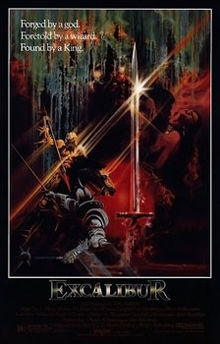
Next on our list is Excalibur, which provides the viewer with perhaps the most complete film telling of the story of the Knights of the Round Table, right along with Monthy Python and the Holy Grail of course, though perhaps a few liberties were taken there 🙂 Directed by John Boorman (Deliverance, Zardoz) is unique in the sense that it received an R rating for its release. Generally, fantasy films tend to be PG or PG-13, especially recently with fantasy blockbuster films and studios needing to reach the largest audience possible for sales. However, the late 1970’s and 1980’s had a few examples in the fantasy genre receiving R ratings for the presence of violence, language and/or sexuality – the first Conan film received an R rating. Anyway, let’s not get hung up on this as the only description of Excalibur. In addition to providing the most complete Knights of the Round Table film depiction, Excalibur does it while showcasing a stacked cast of bombastic British and Scottish actors. Patrick Stewart, Gabriel Bryne and a young Liam Neeson all have roles in Excalibur and provide some pretty energetic, larger than life performances. Overall, Excalibur  gives a complete, though dark and sometimes bizarre portrayal of the Knights of the Round Table. Its another unique fantasy film worthy of viewing.

The_Lord_of_the_Rings_(1978)

Lord of the Rings (1978 animated version) – Tuesday, August 27th at 5:30pm

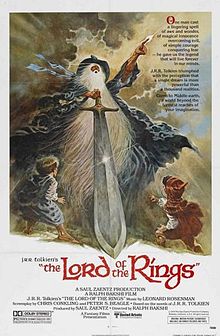
Before Peter Jackson there was Ralph Bakshi. Wait, who? Ralph Bakshi was the director and animator for the original 1978 Lord of the Rings film. For millions of Tolkien fans out there longing for a movie version, for a long time the animated films were the only game in town. In many ways, the animated films are great adaptations and very fun to watch. There is a little confusion regarding the animated films though. There are three animated films from the late 1970’s and early 1980’s that depict the LOTR trilogy as well as the Hobbit. The first film to be produced (The Hobbit 1977) and the last film (The Return of the King 1980) were actually made by a different director (Jules Bass and Arthur Rankin Jr.) and had a very different style and substance. Further confusing things, Bakshi’s Lord of the Rings only covers the plot from the first two books of LOTR. Unfortunately, United Artists and Bakshi seem to have had a falling out and thus he did not make the 2nd film. Hurriedly, the final Return of the King was made by Bass and Rankin, which disappointed fans and completely changed the tone Bakshi had set. However, Bakshi created a very interesting interpretation of LOTR and followed the plot rather faithfully. He created a darker world than the other two animated films and used interesting style and techniques (rotoscoping included) to create the film. There are many who are frustrated that he did not make the 2nd film, and more still that did not necessarily like his animation style. However, I think that this is perhaps almost a MORE faithful adaptation than Jackson’s (there are more than a few problems despite the quality) and one that is unique enough to garner a view.

More Fantasy Films of Late 1970’s and 1980’s

– Written by Matt Latham, Adult Program Coordinator, Reference Librarian