How can a poem centered on metaphors call to the reality of one’s physical and emotional bar? “Neither Out Far Nor In Deep” by Robert Frost is – in my opinion – a very underrated poem. The poem was first published in the Yale Review in 1934 and was included in 1936 in Frost’s collection, A Further Range. The poem plays on the idea of the external vs. the internal by using the metaphor of juxtaposing the sea and land. Frost’s four-line quatrain uses metaphors to expand on the difference of one’s point of view. Indicating this through the narrator and the narration, the voice of the poem alludes on a metaphor of narrowmindedness. Delving deeper into what serves symbolically as the internal, the sea, that being which is out far and in deep. We see the meaning overlap in the third stanza of the poem, “but wherever the truth may be.” Even though the poem speaks of tangible things such as the sea and the land, the word used is “wherever” not “whatever” which indicates that this is about location. Location of what is the real question.
Continuing with this idea of location, the question being posed here is what kind of location this explores. Is it more metaphorical in the sense that it’s allowing the reader to connect with something deeper? Or is it purely taken at face value and is more of a straightforward view on how others may be perceived or even how a place may be perceived through someone else’s view? Both are as equally important observations and go hand in hand with each other.
First, the title of the poem plays on this idea that it’s neither one nor the other, “Neither Out Far Nor In Deep”, which can be interpreted to it either being both or none. Appearing to be about watchers of the sea, the theme has a very literal meaning, if taken at face value, that those who look out into the horizon at the sea do not have much expectations to see beyond what the natural eye can see. But based on the tone of the poem, the narrator challenges the reader to think deeper about the poem, thus dehumanizing the words “one way,” “wherever,” and “bar.”
In the context of the poem and the tone, it can be seen how the narrator looks down or even pities those being spoken of. The question is to why. It is both internal and external pity, as those who choose to look out only into what seems as “never-ending unconsciousness” are betraying what their external bodies are capable of. Stuck in the “quicksand” of narrowmindedness and low expectations, one can never hope to get anywhere in life.
It’s in the beauty of the last two lines of the last stanza that we are illustrated a more complex vision to this poem.
“But when was that ever a bar / To any watch they keep?”
This is what alludes to the reality within the metaphors that the poem is made of. Frost may be portraying a very literal meaning of the juxtaposition of being at sea and land. Or, the way I see it, he may be calling to the very reality of one’s limitations. The ones we place on ourselves as well as the one’s being placed on us, physical, emotional and even spiritual. Frost is basically saying since when is there a bar to how far one can dream, think, envision, and imagine, which therefore lets them be.
Therefore, I love this poem by Robert Frost. The title alone calls attention to this place in one’s reality that states, it’s neither one nor the other, and who says you must choose. It can be both, or it can be none, or it can be one, but the beauty is that even if it is either or, in reality, it’s neither nor.
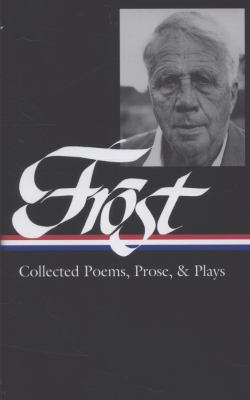
Want to enjoy more of Frost’s poems for yourself? You can borrow the Collected Poems, Prose & Plays by Robert Frost from the Hoboken Public Library; this includes an impressive variety of his work including all his collected poems. You can also check out several ecollections of his poems on Hoopla including The Road Not Taken And Other Poems. Robert Frost: Poetry for Kids features poems specially chosen for kids 8-14 by author and historian Jay Parini and accompanied by illustrations from Michael Paraskevason. For a unique experience borrow Robert Frost: New England in Autumn, which features his autumn themed poems read throughout the farm country of Massachusetts and is available to stream from Kanopy.
Written by
Sherissa Hernandez
Adult Programming Assistant

 Hoboken Library Staff Picks