April 15/16 is Yom H’Shoah, the day on which Jews and other victims of the Nazis remember the horrors of the Holocaust. Six million Jews were murdered by the Nazis, but an additional five to six million people went to their deaths for being gay, political enemies of the Nazis, disabled, Romany, or simply for trying to help their neighbors survive the war by hiding or helping them. There have been other horrific genocides since then, but the Nazis set the template for the horrors of Cambodia, Rwanda, Bosnia, and Darfur.
This year, however, is even more important because 70 years ago, on April 15, the most notorious concentration camp, Auschwitz, was liberated. There will be many commemorations of the event in large part because the remaining survivors will probably not be here for the 75th or 80th ceremonies.
The hardest question many parents and educators ask is when is the right time to start teaching about the Holocaust? The answer will be different for each child. However, it is safe to say that children under the age of six should be shielded from the information. Some picture books that are not too detailed in the atrocities and focus mostly on the aftermath of the liberation of the camps, may be appropriate at age 8. Mostly, however, you will want to look at ages 10 to 13 as the earliest age to introduce this subject to your child.
The list of books on the Holocaust, including first person accounts from survivors, is very long. I could not possibly do a comprehensive list on this blog. However, for guidance in teaching the Holocaust, check out the following websites:
The U.S. Holocaust Memorial Museum: Attached to the Smithsonian in Washington, D.C. this is the most comprehensive resource for information on the Holocaust. If you can visit with your older children, it is an unforgettable experience. You can also access their learning resources at www.ushmm.org/learn.
The National Museum of American Jewish History: Located in Philadelphia, PA on Independence Mall, this is another arm of the Smithsonian. You can find out about their resources, including an internet classroom program, at http://www.nmajh.org/Education/ or education@nmajh.org.
The USC Shoah Foundation: This is the organization that was founded by Steven Spielberg after he made Schindler’s List. Its purpose is to record the testimonies of survivors of the period so that the memories of the victims will be perpetuated.
The Museum of Tolerance: Not only does this resource document the events of the Holocaust, it also works to prevent future events of hatred and even bullying.
This is a partial list of easily available (through your BCCLS.org library) books and films that are appropriate for younger audiences, and adults as well:
Anne Frank: The Diary of a Young Girl, by Anne Frank.

I include this because Anne is arguably the most well-known victim of the Nazis. Her diary, however, ends with her captivity. In addition to the book, which I would suggest for ages 11 and up especially because of the much discussed conflicts between Anne and her mother, there have been several films and plays made based on the diary. The most well-known film was made in 1959 and directed by George Stevens. It is probably the most palatable for younger audiences because most of the serious conflict was removed and the love story between Anne and Peter Van Daam, is sweetly innocuous. It also ends with a hopeful scene of birds wheeling in the Amsterdam sky. Subsequently there was another American TV version made with Melissa Gilbert of Little House on the Prairie fame playing Anne. Frankly, this is an inferior version. The BBC have done at least two productions of the story, the most authentic and effective being Anne Frank: The Whole Story, starring Sir Ben Kingsley as Otto Frank. It is very well done. It is also very graphic because it extends the story to time that Anne and her sister, Margot, spent in Bergen-Belsen before dying of typhus just weeks before the end of the war. There is some mild nudity, but it is the hopelessness of Anne, at this point, that would be very hard for a child to grasp. I would show this film to teens, ages 16 and up.
The Devil’s Arithmetic, by Jane Yolen.

This was an award-winning book, several decades ago. In the book, Hannah, a reluctant participant in Jewish ritual attends her family’s Passover seder where she hears oft-repeated stories of the Holocaust victim whose name she carries. In events similar to the Wizard of Oz, Hannah becomes unconscious and awakes in a Polish village where she befriends her namesake and then is taken to a concentration camp. Things do not go well for Hannah as she hears the doors of the gas chamber close behind her before she awakens, back home in time for D’ayenu. There was a TV movie made of this book which suffered from some misguided casting, with Kirsten Dunst playing Hannah. However, the late Brittany Murphy was actually quite good as the Polish girl from the past.
The Extra, by Kathryn Lasky.
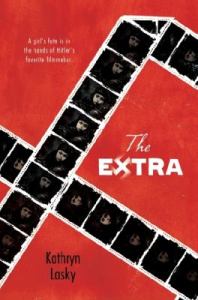
This is an important book for teens primarily because it deals with the fate of the Romany (Gypsy) victims of the Holocaust. A group of Romany inmates including Lilo, a teenage girl, are recruited to help Leni Riefenstahl make movies. Riefenstahl was notoriously Hitler’s favorite movie maker and as the Romany group discovers, she was both a genius and a monster. Adults might pursue the subject by reading Leni: The Life and Work of Leni Riefenstahl, by Steven Bach.
One Candle, by Eve Bunting.

This is the elusive picture book for younger children, grades 3 to 6. In this story, a family shares a much-told tale of how a relative celebrated Chanukah in the camps with a piece of salvaged candle that had to last for eight nights.
Nine Spoons: A Chanukah Story, by Marci Stillman.

Similar to One Candle, this is the story of nine dedicated women who gather spoons, one for each night, so that they can have a makeshift menorah in the camps. Grades 3 to 6.
The Harmonica, by Tony Johnston.

Based on a true story, this book tells the tale of a young boy who was given a harmonica by his father. When he is imprisoned in the camps, the music he makes is his solace. It also attracts the attention of a Nazi officer who commands him to play for him. That music saved many prisoners is a fact. This story is recommended for grades 3 to 6.
The Boy in the Striped Pajamas, by John Boyne.

Bruno’s father receives a promotion that moves the whole family to the countryside. Bruno is particularly unhappy to leave his friends and home behind. He doesn’t understand that his father’s reassignment has made him the commandant of a concentration camp. Bruno goes exploring and makes a new friend on the other side of a barbed wire fence. The two boys, the prisoner and the commandant’s son, meet frequently and, one day, decide to try a trick of changing places. It does not end well for Bruno. This book is frequently referred to as “a fable.” For me the problem comes in the intended age of the readers, perhaps 11 and up, and the age of the protagonist who is much younger. There was a well-received movie based on the book if you wish to introduce it in a different media.
I Never Saw Another Butterfly: Children’s Drawings and Poems from Terezin Concentration Camp, 1942-44.

Image via Amazon
There are several books that deal with the dichotomy that was Terezin (or Theresienstadt). Built on the site of an old Czech fortress, this camp was designed for show, so that visiting dignitaries and the Red Cross would see a lovely village populated by happy Jews. The camp fronted something far more sinister. However, while children were interned there, they were able to take classes in art, music and put on performances. This book is a collection of some of the work the children produced.
Brundibar, by Tony Kushner with illustrations by Maurice Sendak.

This is the beautifully drawn fable of a Czech village. Aninka [in English Annette] and Pepíček (Little Joe) are a fatherless sister and brother. Their mother is ill, and the doctor tells them she needs milk to recover. But they have no money. They decide to sing in the marketplace to raise the needed money. But the evil organ grinder Brundibár [who represents Hitler] chases them away. However, with the help of a fearless sparrow, keen cat, and wise dog, and the children of the town, they are able to chase Brundibár away, and sing in the market square. This opera was actually performed in Theresienstadt to the delight of the apparently clueless SS soldiers.
Fireflies in the Dark: The Story of Friedl Dicker-Brandeis and the Children of Terezin, by Susan Goldman Rubin.

This book covers the years in which the Czech artist, Dicker-Brandeis, was able to help the children of the camp produce art, poems, and stories. Examples are inculded.
Auschwitz Explained to My Child, by Annette Wieviarka.

As her child turns thirteen, the author, the child of Holocaust victims, decides to explain to her daughter the process of historical events that led from Hitler’s rise to power, through the discriminatory acts perpetrated on the Jews, to the incarceration and murder of Jews in the concentration camps.
Let the Celebrations Begin!, by Margaret Wild.

This is an anniversary edition of the original in which a small boy, imprisoned in the camps, enlists women in the barracks where he lives to make toys for other children who will be celebrating the day of their liberation.
The Flag with Fifty-Six Stars, by Susan Goldman Rubin.
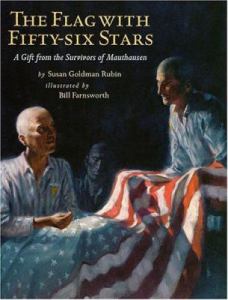
With their liberators on their way, the residents of one concentration camp decide to make a flag to honor the Americans who will save them. Based on a true story, the determination of the men to produce a flag from rags is awe-inspiring. Grades 3 to 6.
On this seventieth anniversary, I quote Yehuda Bauer who said, ““Thou shalt not be a victim, thou shalt not be a perpetrator, but, above all, thou shalt not be a bystander.” Books and movies can train up a new generation that will not be onlookers or perpetrators, but will help to build a better society for all.
-Written by Lois Rubin Gross, Senior Children’s Librarian
Tags: children's literature, children's nonfiction, education, history, holocaust, museums, nonfiction, Yom H'Shoah



 Hoboken Library Staff Picks