Tag Archives: memoir

Say Yes Please to Yes Please

14 Jan

I’ve long been a fan of Amy Poehler’s. My favorite movie of hers is Wet Hot American Summer, which came out before she appeared on Saturday Night Live and will soon be revived as a TV show on Netflix. I follow Amy Poehler’s Smart Girls at the Party on Facebook, Twitter, and Instagram. Not only is she funny, but she seems down to earth. When I heard she wrote a memoir called Yes Please, I couldn’t wait to read it.
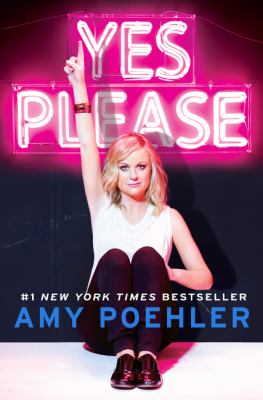
yes-please

Amy chose the title Yes Please because the word “yes” calls back to her improv days (saying yes is the first rule of improv), and “please” means you’re agreeing to not do something alone. She also likes to use the phrase in her personal and professional life. I like that it sounds polite.

Yes Please is written like a series of essays. In the early chapters, Amy describes her family and growing up in suburban Boston, where not much happened so she compensated for that with an active imagination. She also gives helpful life advice, such as “treat your career like a bad boyfriend.” There are several shout-outs to Judge Judy, who I also admire.

Improv has played a huge role in Amy’s career and life. She fell in love with it while playing Dorothy in a grade school production of The Wizard of Oz. She writes about her time with the Upright Citizens Brigade improv group, where she met Tina Fey (whom Amy calls her “comedy wife”, and gets a chapter in the book), Rachel Dratch, Stephen Colbert, among others.

There are stories about her time on SNL, good and bad. (Although she doesn’t dish about which celebrity hosts behaved badly.) She writes about making her SNL debut after 9/11, which was poignant. I remember watching that first episode later that September, where in the cold open SNL creator Lorne Michaels asked then-Mayor Rudy Giuliani for “permission to be funny”. Amy admits to laughing on-air during a Debbie Downer sketch. The characters in the hilarious Bronx Beat sketches, performed with Maya Rudolph, were named after two ladies in the SNL hair department. In the chapter “Sorry, Sorry, Sorry”, Amy talks about a skit that offended a mutual acquaintance that she took a long time to apologize for and her regret over the delay.

It’s hard to choose a favorite chapter from Yes Please, but a contender is “The Day I Was Born”. Amy believes everyone should know about the day they were born. She tells her birthday story, with input from her parents. This prompted me to ask my parents about the day I was born. One highlight from my birthday, according to my mom, is when she found me in the nurse’s station hours after I was born having my hair combed by two nurses. I was born with a full head of red hair, and stood out from the other babies in the nursery.

Amy wrote an entertaining chapter about being nominated for major acting awards like Golden Globes and Emmys, which she nicknamed “the pudding”. To make the experience more fun and less stressful, she planned bits with her fellow Best Actress in a Comedy Emmy nominees. At the 2011 Emmys, Amy and the other nominees came on stage as their names were called and held hands like pageant contestants waiting to hear who gets the crown. The winner Melissa McCarthy received a bouquet of roses and a tiara in addition to “the pudding”.

After I read Yes Please, I loved Amy even more. I’m planning to listen to the audiobook of Yes Please, just so I can enjoy this wonderful book again.

This is my second post about funny lady memoirs, which I plan to continue as a series. (The first post was about Tina Fey’s book Bossypants.) Rachel Dratch has a memoir that I want to read. I’d love to read memoirs by other SNL performers, such as Maya Rudolph, Ana Gasteyer, and Kristen Wiig. Publishing execs, please give these ladies book deals!

Who are your favorite funny ladies? Do you know the story of the day you were born?

-Written by Kerry Weinstein, Reference Librarian

Book Review: I Am Malala, by Malala Yousafzai and Christine Lamb

14 Nov

It is seldom that I devote an entire blog to one book, but this is an important book that tells the story of a very important young woman.  In its own way, it is a book that bears comparison to The Diary of a Young Girl, written seventy years ago by another teenager in harrowing circumstances.  The two young women, living decades apart, share a similar commitment to making a positive difference in the world and a similar belief that, despite their oppressors, there is an underlying goodness in mankind.  It is amazing to find this streak of optimism in both books because both young women saw the very worst that humanity produces aimed at them through an accident of religious identity or gender.

i-am-malala

Malala’s book is ghostwritten by British journalist, Christine Lamb, who treads a very delicate path between achieving a smooth delivery of information while maintaining Malala’s true voice.  The story is skillfully treated.  Malala’s unique story actually begins with her birth.  In a country that prizes sons above daughters, Malala’s father, Ziuddian Yousafzai, proclaims that he is happy to have a daughter and will see her educated just as he would a son.  Ziuddian, who is a teacher by profession, opens a school in Mingora, Pakistan, and from the age of two, Malala is part of the school, sitting on teacher’s laps and learning all that she is able.

Ziuddian cultivates learning in all three of his children, but especially in Malala, a spirit of academic competitiveness that sees her perennially coming out at the top of her classes and winning public speaking contests.  It is interesting that from such an early age, Malala is encouraged to express herself in ways that her illiterate, but strong, mother could not imagine.  Whenever there is an opportunity, Malala learns to speak passionately about subjects as diverse as honor and poetry.  While Pashtun tradition says that girls cannot speak their own words but must speak words written by their fathers or brothers, Malala finds that she must tell her own tale to deliver her speeches with sincerity and meaning.

Through all the challenges of her life – a war-torn country, displacement from her home, attacks on the school by the Taliban – Malala is prescient that someday she will come face to face with the enemies of progress.  She even mentally prepares the speech she will deliver if she is ever confronted by a Taliban.  She plans to tell her attacker that all she wants is for all children to be educated.

Unfortunately, in October 2012, the Taliban comes onto the school bus that she is riding and asks, “who is Malala?” then shoots her in the face.  The rest of the story was widely reported in the media, but Lamb and Malala go through it, step by terrifying step.  Malala, who is deeply religious, might say that Allah was protecting her on so many levels.  By coincidence, a British doctor, Fiona Robinson, who specializes in pediatric intensive care was in Pakistan when the attack happened.  She and Pakistani military doctors treated Malala’s injuries when she was triaged.  The importance of the patient struck the Dr. Robinson when she said, “My God, I am treating Pakistan’s Mother Theresa.”

Malala was air lifted on a Saudi hospital jet to Birmingham, England, on her own.  She awoke, days later, in a strange land without her family and with grievous injuries to her head and left side.  Malala takes us through the process of recovery. (As she says, she now knows a great deal about medical procedures).  She also continues through her quick rise to worldwide fame as a spokesperson for the rights of all children, but especially young girls, to have an education.

In unguarded moments, when she is discussing fights with her best friend or sibling rivalry with her brothers, Malala sounds like any child and that is when the book truly resonates with memories of Anne Frank.  But there is something so mature and focused about this young woman as she talks about her mission in life, to see education come to all children.

The thought that came to me, as I read the book, was that in our country so many children take the gift of education for granted.  Schools that fail, schools that have high drop-out rates, schools that “teach to the test” so that students do not learn to think as much as regurgitate, are a sad, sad statement when measured against Malala’s dedication and determination.

We can question if Malala’s father put her in an unnaturally dangerous situation by promoting his cause for education through his young daughter, but this is clearly now Malala’s cause as well.  Read this book because, God or Allah willing, this child is a future leader of the world and one that all our children should strive to emulate.

Written by Lois Gross, Senior Children’s Librarian