Tag Archives: Kanopy

In Search of Edgar Allan Poe (PBS on Kanopy)

19 Feb

Edgar Allan Poe is much more than the gloomy poet of The Raven or the macabre short story teller of The Tell-Tale Heart. The PBS documentary on Kanopy, In Search of Edgar Allan Poe, stylizes and weaves a much more eye-opening (and I’d say heartbreaking) ode to one of American Literature’s greatest.
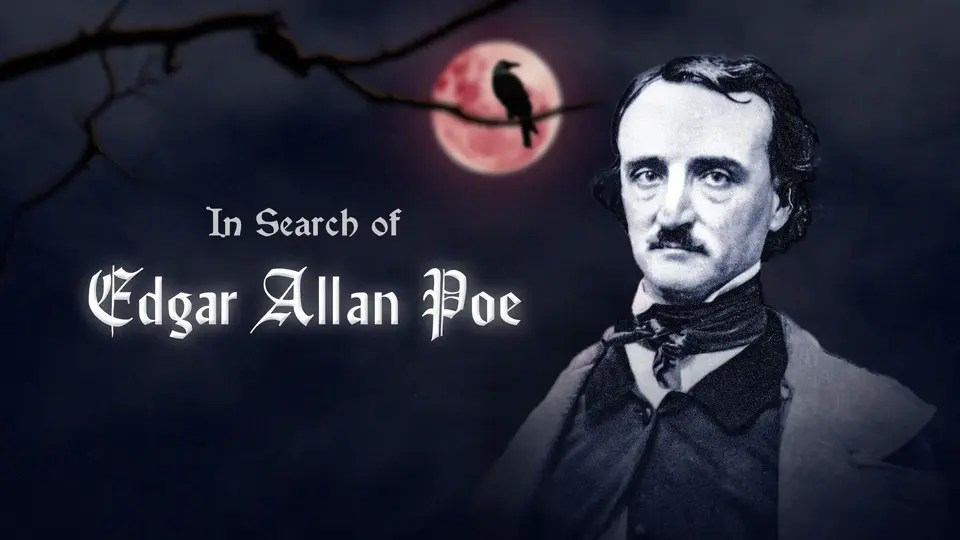
Image featuring a portrait of Edgar Allan Poe against a dark background with a full moon and a silhouetted raven perched on a branch. The text reads “In Search of Edgar Allan Poe.”

It’s two 90-minute parts, exploring Poe’s imaginative brilliance, his inspiring resilience, and his undying ambition through life-long hardship.

More Than the Macabre

Poe, of course, is rightfully celebrated as the inaugural king of haunting tales. This special taught me that he was also one of the most innovative writers in our country’s history – before Sir Arthur Conan Doyle’s Sherlock Holmes or Agatha Christie’s Poirot, Poe trailblazed the detective story with The Murders in the Rue Morgue. Before Jules Verne and H.G. Wells, he experimented with science fiction through stories like The Balloon Hoax. And his fascination with cryptology in The Gold-Bug helped inspire Robert Louis Stevenson’s Treasure Island.

Sir Arthur Conan Doyle acknowledged Poe’s influence in his first Sherlock Holmes story – Watson compares Holmes to Poe’s detective Dupin.

The closing credits roll like a who’s who of authors influenced by Poe. 

Poe’s Unity of Effect is also explored, the theory that every word, every line, every image in a short story keeps the reader grounded in one emotion – fear, grief, dread, isolation, etc. And that stories at their full potential should be enjoyed in one sitting. 

The documentary also confronts many misconceptions, particularly about Poe’s personal life and alcoholism. He had demons and addictions. There’s no denying that. It’s tragic and heartbreaking, yet the series unmasks a man marked by early loss, financial struggle, and deep devotion to his ailing wife – massive anxieties and demonic possessions all intermingling with his fascination for the writing craft.

And while Baltimore may claim him as one of their own, the series reminds us that Poe also belongs to more than just Baltimore. In Philadelphia, where he wrote The Tell-Tale Heart and grew his dream of starting a literary journal, and in New York City, where he penned The Raven, he lived out his last days in a cottage with his ailing wife in the Bronx. Here, he wrote his romantic ode to her, Annabel Lee (You can visit the cottage for tours.)  

I came away both haunted and in awe of this literary genius and how much modern storytelling has this man’s dark yet imaginative mind to thank. 

Watch now on Kanopy: In Search of Edgar Allan Poe (PBS)  (Free with your library card)

Comment below your thoughts once you’ve had a watch.

Hit subscribe to get Hoboken Public Library Staff Picks to your email!

Written by:
Sean Willey
Information and Digital Services Assistant

Commemorating Women’s History Month with Documentaries featuring a New Jerseyan Nobel Laureate, Maria Ressa 

2 Mar

Hello everyone! My name is Bernadette, and I’m the new Information and Digital Services Librarian at the Hoboken Public Library. Before I came to HPL, I had internships at New York Public Library, Pratt Institute Libraries, and the independent news program Democracy Now!. In the Philippines, I worked at the National Film Archives of the Philippines and the Cinematheque Center Manila, where I developed a love for cinema that engages communities and inspires social justice and societal transformation.

COMMEMORATING WOMEN’S HISTORY MONTH
March marks Women’s History Month, which celebrates women’s contributions to history, culture, and society. The National Women’s History Alliance designated the 2022 theme as “Women Providing Healing, Promoting Hope.” Immediately, this theme made me think of the remarkable Filipino journalist Maria Ressa, who was awarded the 2021 Nobel Peace Prize for her courageous fight for freedom of expression in the Philippines and around the world. Not only is she a Nobel Laureate, she is a Princeton alum and proud resident of New Jersey. 

As a journalist and CEO of the news outlet Rappler, she has defended human rights by shedding a critical light on Philippine president Rodrigo Duterte’s controversial “war on drugs,” which has killed tens of thousands of Filipinos in the last five years. Because she exposed his administration’s track record of corruption, state-sanctioned violence, disinformation campaigns, and repression of the people, Rappler—and Ressa herself—was targeted by the Philippine government. 

Ressa’s struggle for truth, democracy, and freedom of the press in the Philippines is chronicled in two thrilling political documentaries available with a Hoboken Public Library card.

A THOUSAND CUTS
Directed by Ramona S. Diaz, the documentary A Thousand Cuts depicts the war between the press and the government, between truth and disinformation. Ressa and her team combat falsities spun by government officials seeking to lie their way to power. The Philippines’ democracy hangs in the balance—and so does Ressa’s own life and freedom. 

It is available to borrow on DVD from the Hoboken Public Library – BCCLS Libraries.

WE HOLD THE LINE
Another documentary We Hold the Line follows Ressa and her team. It gives the audience rare behind the scenes access as her team continues their brave journalism amidst threats to their work and lives. The documentary weaves together narratives from various perspectives—victims of the drug war, critical politicians in hiding, and even members of death squads commiting summary executions—to give insight into the real “war on drugs” of president Duterte.

We Hold The Line is available for streaming on Kanopy with a Hoboken Public Library Card.

IN RESSA’S WORDS
The Duterte government’s systematic crackdown on press freedom has led to 114 documented cases of attacks against media practitioners and journalists in the Philippines, including 19 killings. These attacks come at a critical time and weakens democracies globally, polluting the atmosphere of information dissemination. What can the community do when the people and the truth itself are under attack?

Ressa shared her wisdom and calls to action in her Nobel Peace Prize lecture delivered last December. “We’re at a sliding door moment, where we can continue down the path we’re on and descend further into fascism, or we can each choose to fight for a better world. … The destruction has happened. Now it’s time to build – to create the world we want.”

Written by:
Bernadette Patino
Information and Digital Services Librarian