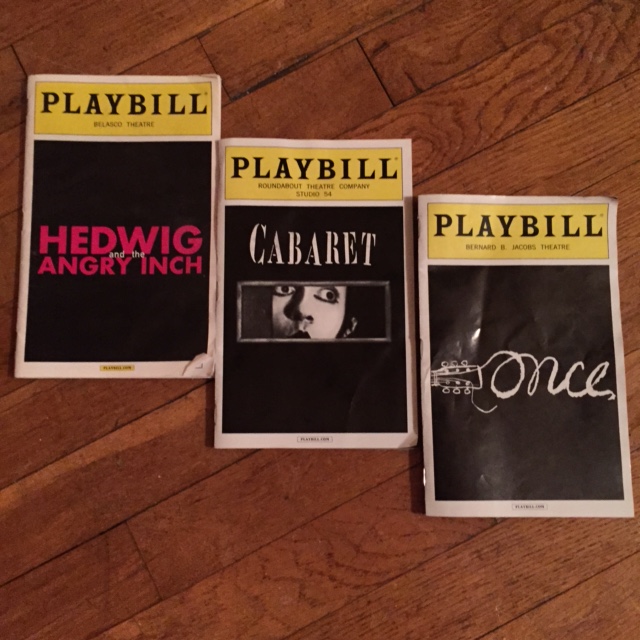
I had the opportunity to see three Broadway shows in the past few months: Hedwig and the Angry Inch, Cabaret, and Once. After seeing the live shows, I watched the film adaptations, or the origin film in the case of Once, to relive the music, the stories, and the characters. While the films can’t recreate the experience of live theater, I enjoyed them all. All three films are available to borrow from BCCLS libraries. I also include catalog links to the soundtracks if you’re more interested in the music.
Hedwig and the Angry Inch
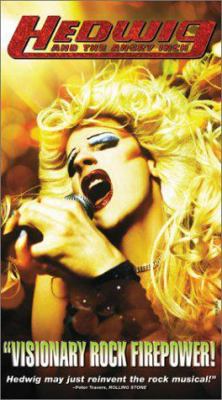
Hedwig and the Angry Inch (both film and stage show versions) is primarily a story about of a lover scorned, with a killer rock and roll score. The action follows Hedwig (born Hansel), a transgender woman from East Berlin, as she follows her former lover, rock star Tommy Gnosis, on his American tour. Hedwig, who has her own band called The Angry Inch, is responsible for many of Tommy’s hits and is angry she never received credit. Love, finding your “other half”, power, and gender are other themes explored in Hedwig.
The music is mostly the same in both versions, but the film has some plot differences. Hedwig and her band perform in a fictional chain restaurant called Bilgewater’s as she follows Tommy’s tour. Character actress Andrea Martin (author of a Funny Lady Memoir called Lady Parts) plays Hedwig’s manager, a role that does not exist in the stage show.
The film was released in 2001 and has some references that may seem dated now. Yitzhak, Hedwig’s husband and a member of The Angry Inch who has aspirations of his own, quits to perform in a touring production of Rent. These details in no way will diminish a viewer’s enjoyment of the film. Just try not to sing along to “Wig In a Box”, which Hedwig invites the viewer to do as the lyrics of the song appear on the screen. This film is so much fun to watch.
John Cameron Mitchell, who played Hedwig in the film, is currently starring in the stage show. How cool would it be to see him on stage, then watch the film?
Cabaret
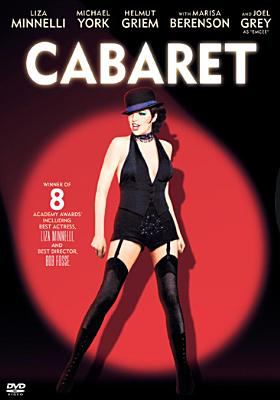
Cabaret is set in 1931 Berlin, when the Nazi party was gaining power. The action is centered at the Kit Kat Club, a sexy but seedy place where the Emcee (Joel Grey) is the host and Sally Bowles (Liza Minnelli) is the headliner. Joel Grey and Liza Minnelli both won Oscars for their roles in the movie, and Bob Fosse won for Best Director. However, the movie could not beat The Godfather for Best Picture that year.
To me, Liza Minnelli is the ultimate Sally Bowles. My first exposure to this show was hearing a recording of “Cabaret” sung by Minnelli on a CD compilation of great Broadway songs called Ultimate Broadway. I was enthralled and persuaded my parents to let me see the 1990s Broadway revival at Studio 54, which starred Gina Gershon as Sally Bowles and Alan Cumming as the Emcee.
Seeing the musical reminded me how dark the story is, and the movie definitely captured that tone. There is just a sense of foreboding throughout the film, and the final image confirms that dread. Listening to the song “Cabaret” on its own makes the show seem lighthearted and fun, with upbeat chords and lyrics like “Life is cabaret old chum, so come to the cabaret!” But that performance comes toward the end of the film, when Sally sings it in desperation to save the career she wants and has sacrificed for. Perhaps Cabaret feels ominous because history documents the results of the Nazi regime.
Cabaret is soon ending its run on Broadway, but the movie and soundtracks are available.
Once
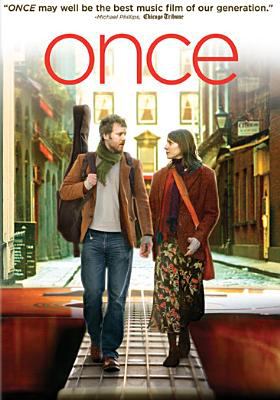
Once is an anomaly here. The stage show, which made its Broadway debut in 2012 and ended its run this past January, was adapted from the 2007 Irish film. Glen Hansard and Marketa Irglova star as Guy and Girl, respectively, who connect over music and spend a creative week together writing and recording original songs. The film was a hit and won a Best Original Song Academy Award for “Falling Slowly” in 2007. While “Falling Slowly” is certainly a gorgeous composition, I have to say “Gold” is my favorite song from both versions.
Girl meets Guy as he is singing on the street. They chat, and he tells her that he fixes vacuums for a living. She announces that her vacuum “doesn’t suck” and the next day she brings the vacuum to him for repair. The vacuum becomes a comic gag, as Girl drags it along with her as she and Guy go for lunch, ride the bus, and get to know each other.
The movie feels more like a musical performed in the theater, as the songs the characters sing express their thoughts, feelings, and experiences. In “Broken Hearted Hoover Fixer Sucker Guy”, Guy explains to Girl how his ex-girlfriend broke his heart and left him behind. Girl is estranged from her husband, with whom she has a young daughter. This pair has so much in common and there is definitely chemistry, which their music captures.
I saw one of the last performances on New Year’s Day, and was glad to experience this show (and hear “Gold”) live.
What are your favorite Broadway shows or film adaptations of musicals?
-Written by Kerry Weinstein, Reference Librarian


 Hoboken Library Staff Picks