I’ve always loved reading about people. As a kid, my first stop in the library was usually the biography section. My school library had only one set of biographies that had perhaps five titles about women. If I remember correctly, the women who were documented in this series were Eleanor Roosevelt, Maria Mitchell, Juliet Gordon Lowe, Martha Washington, and Helen Keller. All the other books, the ones about inventors and adventurers and leaders of state, were about men. Girls of the 1950s and 1960s did not expect more. We were, after all, going to become mothers, teachers, secretaries, or nurses. What girl would aspire to a career that might interfere with keeping house and raising children?
Fast forward fifty or so years. While biographies are still overwhelming about male achievements, there is a conscious effort by (women) writers and publishers to feature pioneering women in the pages of books. While it still saddens me to see girls staring at assignment sheets that routinely list George Washington, Martin Luther King, John Kennedy, et al, as their assigned reading, if they – and their teachers – are willing to stray from the curriculum, there are many books about women who led interesting lives. As recent weeks have proven, we need strong female leaders with interesting and inspiring role models. Here are just a few to share with contemporary girls and boys, alike:
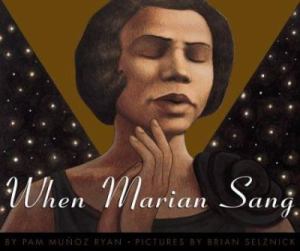
When Marian Sang, by Pam Munoz Ryan, illustrated by Brian Selznick. The rich contralto voice of Marian Anderson is something I heard as a small child in my home. The beauty of her voice could best be described as a vocal cello, incredibly smooth and powerful. However, as a young African American woman, American stages were off-limits to the Philadelphia girl so, like many Black singers before her, she went to Europe to learn and sing. In 1939, she returned to the United States to perform a concert in Washington D.C.’s Constitution Hall, only to have her performance blocked by restrictive rules. It was Eleanor Roosevelt, the First Lady of the United States, who intervened and had Ms. Anderson sing in front of the Lincoln Memorial on Easter Sunday, the powerful symbolism of which resonates even today.

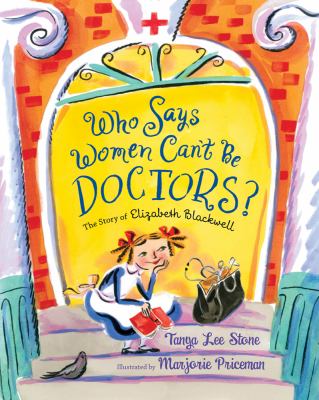
Who Says Women Can’t Be Doctors? The Story of Elizabeth Blackwell, by Tanya Lee Stone, illustrated by Marjorie Priceman. Although this is just a bit more than a picture book, it tells the story of the first woman doctor in America who, despite repeated rejections by medical schools, persevered to be admitted to medical school. Her classmates and the school administration thought that she would not have the strength of drive to become a doctor, but they underestimated her determination. Information in the back of the book states that Blackwell and her sister, Emily (also a doctor), started their own hospital, the New York Infirmary for Women and Children.

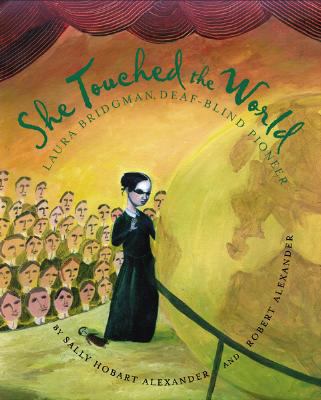
She Touched the World: Laura Bridgeman, Deaf-Blind Pioneer, by Sally Hobart Alexander and Robert Alexander. Before Helen Keller became the most famous and representative blind and deaf individual in the world, Laura Bridgeman led the way. Bridgeman was subject to a seizure disorder as an infant, and later contracted scarlet fever, likely the cause of her disabilities. Despite her sensory limitations, Laura learned to communicate through Braille and finger-spelling and met the celebrities of her day just as Helen Keller did, years later. In fact, Laura Bridgeman helped to educate Ann Sullivan, the woman who would become known as Helen Keller’s “teacher” when she was a student at the Perkins School for the Blind.

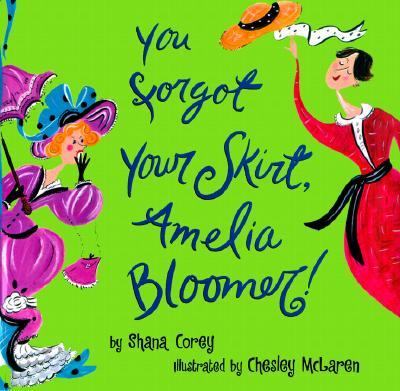
You Forgot Your Skirt, Amelia Bloomer, by Shana Corey, illustrated by Chesley Mclaren. A somewhat fictionalized and colorfully illustrated biography of suffragette Amelia Bloomer’s most famous accomplishment: the popularization of women’s trouser. With other members of the Ladies’ Temperance League Bloomer, who also fought for women’s right to vote and started her own women’s newspaper, popularized the less constricting style of women wearing full-legged pants which, while still worn beneath dresses, gave women more freedom of movement in a time when corsets and constricting undergarments often actually caused women to be unable to breathe, properly.
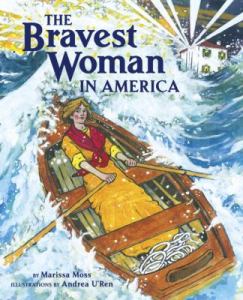
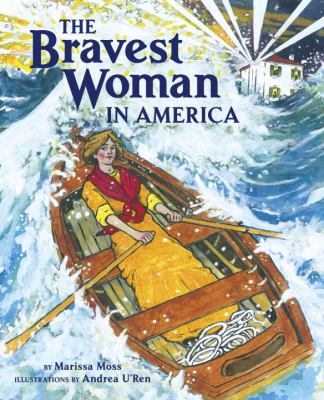
The Bravest Woman in America, by Marissa Moss, illustrated by Andrea U’ren. A little known heroine, Ida Lewis was the daughter of a lighthouse keeper who shadowed her father in his job and eventually took over care of the lighthouse. Often, in her thirty-nine years of caring for the Lime Rock Lighthouse, she was called upon to row out into dangerous seas to save travelers in danger. In 1874, she was recognized for her heroism with the Congressional Life Saving Award.

Amelia Earhart: the Broad Ocean, by Sarah Stewart Taylor and Ben Towle. Aviatrix Amelia Earhart has been the subject of many works of biography and film, not just because of her trailblazing efforts as a female flyer, but because of her mysterious disappearance in the South Pacific. This time, her story is told in the form of a graphic novel, in tones of blue, black and white, tracing her life from pioneering woman who tirelessly promoted women’s rights with her triumphant crossing of the Atlantic in 1928, to her disappearance that remains a mystery, to this very day.

Eleanor: Quiet No More, by Doreen Rappaport, Illustrated by Gary Kelley. Everyone has personal heroes, and Mrs. Roosevelt has always been one of mine. From an orphaned and emotionally abusive childhood, Eleanor took the lessons of noblesse oblige very seriously. When she married her distant cousin, Franklin Delano Roosevelt, she was given a world platform to push for causes of caring for the poor and downtrodden. Since her husband was disabled by polio, Eleanor became “his legs” and overcame her crippling shyness to speak out on behalf of FDR’s “New Deal” policies. After her husband’s death, an event that rocked the world at the end of World War II, Mrs. Roosevelt was appointed by her husband’s successor; harry Truman, to a post at the United Nations where her good works continued on behalf of the world’s people.
I am pleased to say that I could continue this list with many more books about pioneering women. Young girls no longer have to wonder if they can make a difference in the world, only when and how. Starting with good role models in books is a great way for today’s girls to learn by example.
– Lois Gross, Head of the Children’s Department
Tags: books about women for children, children's nonfiction, female leaders, female role models, hoboken library, lois gross






 Hoboken Library Staff Picks