Haunted Houses: The Supernatural Enhancements and The Hawley Book of the Dead

15 Apr

Now that the weather is finally getting warmer you may be planning to go camping.  What better book to bring with you then something suspenseful.  If you are looking for something slightly spooky, but not the typical horror fare here are two uncanny stories about haunted houses with a twist. 

The Supernatural Enhancements, by Edgar Cantero.

supernatural-enhancements

Edgar Cantero was born in Barcelona and this is first novel written in English.  I read The Supernatural Enhancements during the week leading up to Halloween last year.  It has spooky elements of horror, but contains so much more.  The Supernatural Enhancements refers to the unusual attributes of Axton House, inherited by the Irish protagonist of the novel A. from a distant wealthy relative living in Virginia.  The novel unfolds in a variety of ephemera that were collected during A.’s inhabitance of the house along with his younger, mute punk companion, Niamh; these include entries from dream journals, letters, advertisements, transcripts of security video footage and more.  Fans of more traditionally structured works may find the structure of The Supernatural Enhancements frustrating, but I was charmed by Cantero’s quirky sensibilities.  Since the novel is told through scraps of different things it has the added mystery of things that are hinted at but not said.  The Supernatural Enhancements is compelling enough that it could have been told without the unusual format, but I felt due to the nature of the tale it felt well suited to it and it kept the structure from feeling purely gimmicky. The title and format immediately put me in mind of the found footage horror movies such as Paranormal Activity.  Part One of the book seems like a classic haunted house tale where the foolish inhabitants are more curious than afraid of the ghost, however, as the novel progresses it turns into a much more complex and unusual tale.  I was surprised by, but happy with the direction the novel took in the end.

The Hawley Book of the Dead, by Chrysler Szarlan.

hawley-book-of-the-dead

The Hawley Book of the Dead is Chrysler Szarlan’s first novel, and the beginning of a quartet of books.  Like The Supernatural Enhancements, it takes the idea of a haunted house and magic and takes it in unexpected directions.  This book’s ominous title seemed like the perfect choice for this past March’s Friday the 13.  However, it is more akin to Deborah Harkness’s Discovery of Witches than a horror novel.  The Hawley Book of the Dead is the story of Reve (Revelation) Dyer, a magician along the lines of Criss Angel.  I liked how Szarlan used her own experience as a magician’s assistant in the creation of the book.  Reve and her husband live happily in Vegas where they perform together and raise their three daughters.  But one night Reve shoots her husband on stage with a gun that should have contained only blanks, which leads her to realize that she is being stalked.  She flees across country to Hawley Five Corners, an old New England town that her family helped found and the locals believe is haunted.  Reve (whose nickname is the French word for dream) and her daughter have nightmares that seem to be portents.  All the women in Reve’s family have unusual abilities such as healing or her ability to disappear.  The Hawley Book of the Dead is mostly told from Reve’s point of view, but also includes chapters of third person narration about her youngest daughter, and texts sent between her two teenaged twins.  I found The Hawley Book of the Dead hard to put down and found myself always wanting to read just one more chapter before I went to bed.  The novel feels self-contained in that it has a satisfying ending, but there are several subplots that seem likely to pop up in future novels, which I’m looking forward to checking out.

-Written by Aimee Harris, Head of Reference

Kids Interacting with Books

8 Apr

Stephen Sondheim once wrote, in Gypsy, you got to have a gimmick and that seems to be the popular theme of today’s picture books for children.  It’s no longer enough to have beautiful pictures or glorious words.  The book has to be able to DO something and the child has to be engaged in the manipulation of the book or the story so that they’ll get to the end and start reading it again.

This is not a new phenomenon, but it has certainly picked up speed since the introduction of books by the French artist, Herve Tullet.  Tullet’s books, which actively engage the child in pushing, shaking, tilting, and turning the book, were quickly imitated and a whole new genre seems to have been born.

Naturally, these books depend more on illustrations that on words (with one notable exception), and call on the nascent humor of the child and the adult reading the book to improvise a relationship with what the author or illustrator has produced.

These are sure-fire kid-pleasers and, if your child doesn’t already have titles in this list in their personal library, you might want to go out and get them.  Also, these are terrific presents for other children in your life.

I like to say that these are interactive books that require no batteries and absolutely no screen time; just the amazing imagination of a child:

Press Here, by Herve Tullet.

press-here

The minute the child opens this book, he is engaged in activities.  The book directs the reader to press on dots, by number or color, to make them multiply.  Shaking the book makes all of the dots slide to one side or the other of the page.  Inverting the book makes the dots fall to the top or bottom of the page.  The book is on heavy stock and will take quite a bit of handling, but if your child loves it as much as most kids do, you might want to stockpile an extra to replace the first when it wears out.  When your child tires (it won’t happen!) of Press Here, you can move on to Mix It Up! which teaches colors and color mixing with the same “fingers on” approach, or Help! We Need a Title! which involves a monstrous assortment of characters in search of an author (et voila!  Tullet!) to produce a book.  Tullet makes a guest appearance as do a couple of referential jokes about his other books.  Great fun!

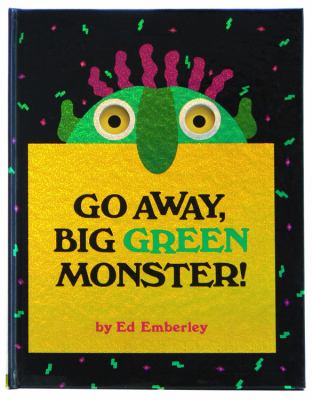
Go Away, Big Green Monster!, by Ed Emberly.

go-away-big-green-monster

Emberly, whose color-splashed, wildly drawn illustrations have been around for a while, pre-dates Tullet in reader involvement in his books.  This title is one we use regularly for non-scary monster story times. A black page with yellow eyeballs appearing in two holes starts the book and, with each turn of the page, the child builds, the elements of a monster face.  Giving the child control of the process, it is then time to make the monster go away so each page takes away one of the monstrous features.  At the end, the child has banished the monster and admonished him not to come back again.  At which point most kids scream, “Again,” and the monster building reemerges.

Tap the Magic Tree, by Christie Matheson.

tap-the-magic-tree

If imitation is the sincerest form of flattery, Matheson sincerely flatters Herve Tullet.  The illustrations, however, are more realistic, picturing a tree in different seasons with leaves and fruit coming and going at the child’s command.  The child can knock on the tree trunk to make apples fall off, or blow away autumn leaves ready to fall.  The clap of a child’s hands bring snow (please stop clapping, kids!) and as winter turns to spring again, birds nest in the tree and the process stars over.

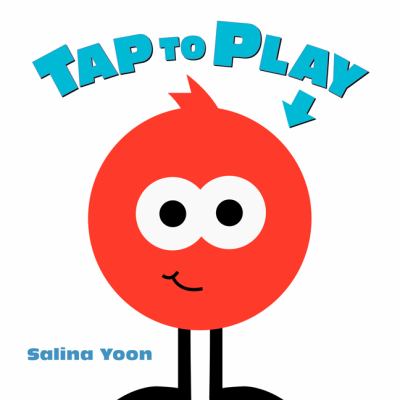
Tap to Play, by Salina Yoon.

tap-to-play

If children drank (well, I hope they don’t) we could play a drinking game with each book that involves the word “tap” in the title.  This book, however, also features an adorable, animated dot named Blip, who has big round eyes.  Blip grows and shrinks, changes form and appearance based on the child’s manipulation of the book.  The book is framed as a game that the child and Blip are playing with the final result being Blip taking off, birdlike, and finding a Blippette girlfriend at the end of the book.  Kids will love it.

Duck! Rabbit!, by Amy Krouse Rosenthal and Tom Lichtenheld.

duck-rabbit

This award winning book from several seasons back plays on the optical illusion of a shape that can be either or a duck depending on your perspective.  An off-page voice debates as to whether the long protuberances are a duck’s bills or a rabbit’s long ears.  The duck/rabbit is tempted with carrots or bread to see which he responds to.  Water might be cooling or a place to swim.  The mystery of the ambiguous animal is never quite solved only to be replaced by an equally ambivalent anteater/dinosaur.

Warning: Do Not Open This Book!, by Adam Lehrhaupt.

warning-do-not-open-this-book

Any book that involves monkeys is bound to be funny.  So a book that is full of monkeys, baboons and apes has to be really, really funny.  However, kids have to be careful not to let the monkeys out of the book.  You know what happens when you let monkeys out of a book, right?  They all go a little crazy.  So does the book especially when they come up against an alligator.  But the child has control of the style.  The reader gets to set a monkey trap with, what else, a banana.  Then, under strict instructions from the author, the reader is told to close the book, but only till he or she opens it again and lets the monkey shines begin!

Can You Make a Scary Face?, by Jan Thomas.

can-you-make-a-scary-face

Jan Thomas has a whole series of interactive, boldly colored books that will not just engage your child, but reduce both of you to tears.  A very bossy (male) lady bug demands that your child stand up, sit down, eat a bug, blow it out of his mouth, and summon a gigantic frog.  For full effect, your child must do EVERYTHING the book tells him or her to do.  Two suggestions: the second time the bug tells your child to “Stand up,” you might tell them to sit down even though it isn’t written.  Otherwise, your child will be standing for the rest of the book.  Also, this lady bug needs a personality to be really funny.  When I tell it, he sounds like a refugee from a gangster movie.  You can develop your own character to make him both bossy and a scaredy cat.

The Book With No Pictures, by B.J. Novak.

book-with-no-pictures

This book has been the absolute hit of the year, written by B.J. Novak, the head writer of the TV show The Office. (He also played Ryan, the temp, Michael Scott’s long-suffering punching bag).  Novak has taken a book and proved that you don’t need pictures to make a picture book.  All you need is a gullible adult who is willing to do what the book says, whether it is to say nonsense words or read gross-out phrases like “Boo Boo Butt.”  That’s as bad as it gets. Honest.  The final page, when the reader has to go through a series of sounds, squeaks, and yodels to please the listener will have the kids in stitches and begging the reader to start again.

These books may not be lyrical or lovely, but they are certainly a lot of fun and they are guaranteed to give your child a new love for reading in all of its inventive forms.

-Written by Lois Rubin Gross, Senior Children’s Librarian