Archive | Nonfiction RSS feed for this section

Staff Picks for Poetry Month – Part 1

15 Apr

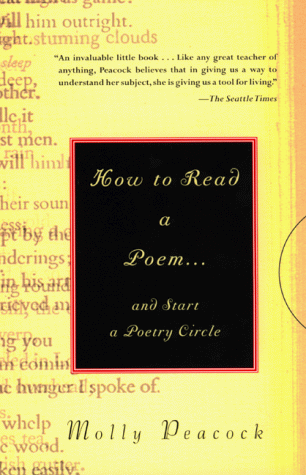
How to Read a Poem…and Start a Poetry Circle by Molly Peacock
how to read a poem

Do you have doubts about your ability to read and understand poems? Do you nonetheless long to have poetry be a part of your life? If so, Molly Peacock’s How to Read a Poem…and Start a Poetry Circle may be the reading companion you’ve been looking for.

Part memoir, part reading guide, How to Read a Poem is a lyrical, personal exploration of the power and nuance of poetry. Peacock shares her own love of the art, describing how her favorite poems not only speak to her, but often speak for her, articulating aspects of her inner life that she herself had never found words for. This is true, she admits, even of poems she finds hard to fully comprehend. In other words, sometimes our bodies intuit the meaning and relevance of certain poems before our minds manage to decode them.

To help readers in our own deciphering of poems, Peacock invites us to think about poetry as a fusion of music, storytelling, and painting, with the line forming the music, the sentence telling the story, and the image showing us the poet’s vision.

She describes her joy not only in reading poetry for and by herself, but in sharing poems with friends who share her passion for the form. She tells of intimate gatherings where she and her companions each bring out a favorite poem—their talismans Peacock calls them since she carries beloved poems with her like charms—to read aloud over a meal. Whether two friends participate or many more, this reading to one another constitutes what Peacock calls a poetry circle. She states simply, “A poetry circle occurs when the mutual reading of poetry is at hand.”

Finally she offers an anthology of her talismans, with personal stories and startling insights to go with each poem. Thus, by reading Molly Peacock’s love treatise to poetry we become a part of her inner circle of poetry friends.

Immersed in Verse: an Informative, Slightly Irreverent and Totally Tremendous Guide to Living the Poet’s Life by Allan Wolf

Immersed47K

Immersed in Verse is a guide for teens interested in reading poetry, writing poetry and generally living like a poet. While the book’s style is playful and inviting, the advice within is serious and sound, making it a great introduction to poetry for beginning writers of any age.

Wolf summons readers to “plunge into words”, to notice with all our senses how the world we live in touches and affects us. “Poems,” Wolf tells us, “are all around us waiting to be written.” He defines poetry as a communication of what’s inside us and invites readers to write about the things that catch our attention, burst into our minds, or live in our hearts. His enthusiasm for looking at the world as a poet does, fully awake, is inspiring and contagious.

Wolf then offers a ‘guided tour’ of the various types of poems—rhyming, free verse, sad poems, funny poems, teaching poems, apologizing poems, love poems, hate poems, dialogues, riddles and more. “By opening up the possibilities of what a poem can be,” he tells us, “you discover a diverse buffet.”

We learn the nine habits of highly successful poets, including doing more and watching less, writing every day, and being playful with words. Wolf also gives quick digestible lessons on metaphor, simile, personification, meter, rhythm, repetition and internal and external rhyme. He offers assignments and prompts to inspire writers and help us jumpstart their poems. Finally, Wolf provides tips for performing poetry, hosting a poetry bash, making our own poetry books and seeking publication.

Immersed in Verse is a fun and thorough introduction not only to writing poetry but to choosing poetry as a way of life.

– Ona Gritz, Young Adult Librarian

 Click on the picture of either book to reserve a copy for yourself!

how to read a poem Immersed47K

A Fashionable Read: Grace, A Memoir

18 Mar

Who is Grace Coddington, the woman behind this fascinating memoir?

Grace a Memoir

Grace is the creative director of Vogue*, arguably the most influential modern fashion publication today. Her primary responsibility is styling and executing many of the fashion photo shoots that appear in the magazine each month.

Anna Wintour, Vogue’s formidable editor-in-chief whose icy, composed persona inspired the Miranda Priestly character in the book and film The Devil Wears Prada, is the most visible figure associated with the brand.

Grace was behind the scenes until The September Issue, a documentary that followed the Vogue staff as they created the eponymous issue in 2007, premiered in August 2008.

In the film, Grace cursed when frustrated and was occasionally ornery with the filmmakers that trailed her as she worked. She was the anti-Anna. This all made her a breakout star.

Although The September Issue has brought much attention to Grace, she has a long history in fashion that she recalls in this memoir.

Grace’s story begins with her childhood in Wales, where she saw her family’s home used as a base for the British military during World War II. But the action starts after she moved to London to start a modeling career in the early 1960s–just as the decade started swingin’.

She was one of the first to sport Vidal Sassoon’s famous five point haircut. She modeled for Mary Quant, the designer who brought miniskirts into fashion. She almost had a dalliance with Mick Jagger before the Rolling Stones hit it big.

Her modeling days ended in the late 1960s after sustaining injuries in a car accident, so she took a job at British Vogue. Over the years she rose through the ranks, and eventually landed at American Vogue in 1988 when Anna Wintour became editor-in-chief.

Throughout her career, Grace has collaborated with an impressive roster of photographers, designers, hairstylists and makeup artists, models and supermodels, and celebrities. She wrote about these relationships, dropping a lot of famous names. But it flows with the narrative.

In the book Grace shared plenty of juicy anecdotes about in-fighting among Vogue editors, as well as supermodels (i.e. Kate Moss) and celebrities (i.e. Mike Tyson) behaving badly on photo shoots. My favorite story is about a model that flirted with Grace’s partner, Didier, during a shoot, and Grace expressed her displeasure by “accidentally” sticking the model with pins when adjusting her outfit.

There is substance behind the style in this book. Grace wrote honestly about her two divorces and her sister’s untimely death, after which she adopted and raised her nephew. A whole chapter is devoted to her decades long friendship with Liz Tilberis, who was editor-in-chief of Harper’s Bazaar magazine (a rival to Vogue) in the 1990s.

Many color photographs from Grace’s modeling career and her fashion spreads in both British and American Vogue appear throughout the book, which bring her stories to life and demonstrate her distinct romantic, British aesthetic.

Grace’s original pen-and-ink illustrations of herself, her Vogue colleagues (many are featured in the book’s end papers), scenes from her life, and her cats are included throughout as well.

I must mention that there is an entire chapter about Grace’s cats, past and present. She had a cat named Puff, after the rapper P Diddy–an instance of the previously mentioned name dropping. I think she loves cats more than fashion. Grace even appeared on Martha Stewart’s talk show in a segment about cats, which she recounted in the book.

I enjoyed visiting Grace’s fashionable world and was sad when the book ended. Grace is witty and an engaging storyteller. Her frank tone shows that she doesn’t take herself, or her new fame, too seriously.

If you’re interested in fashion, Vogue, or Grace–and even cats–this is an excellent book to check out. The September Issue is also a good complement to this book.

Fashionably Yours,

Kerry Weinstein, Reference Librarian

*Stop by the Reference Department on the second floor to borrow current issues of Vogue, and other fashion magazines! 2012 back issues are also available.