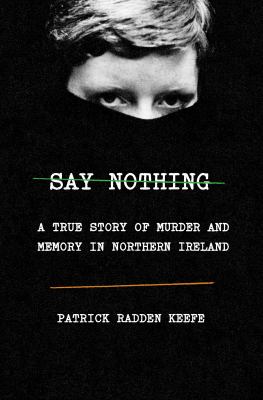
Growing up in the 1990s, I had a vague awareness that there was a conflict in Northern Ireland between the Irish Catholic and British Protestant populations, but my understanding of what is called “The Troubles” didn’t go much deeper than that. It was hard for me to understand why Belfast was one of the most dangerous cities in the world when the rest of western Europe had entered a sustained period of peace following World War II. Say Nothing by Patrick Radden Keefe is not just a great true crime story about the unsolved crime of a mother who was abducted and murdered during this time period. It is also a great introduction to a history of the brutal violence that rocked Northern Ireland for decades and the complex historical reasons why that violence was so intractable for so long.
Most of the main characters in Say Nothing are members of the Provisional Irish Republican Army (IRA), a group who became known for their violent tactics after a peaceful civil rights movement in Northern Ireland had failed to bring about change. Many IRA members weren’t even out of their teens when they joined paramilitary gangs and helped carry out bombing campaigns against the British. Although they faced ruthless discrimination by the British, there is no doubt that the IRA was responsible for a wave of terror that killed civilians. While they were seen as folk heroes to some and terrorists to others, Keefe is less interested in condemning or praising the IRA than in exploring how people turn to violence, how we justify continuous cycles of violence, and how people reckon with their violent pasts.
The Troubles is very recent history and many of the people who participated in the violence are still alive and active in public life. Although the violence in Northern Ireland has decreased tremendously since the Good Friday Agreement of 1998, the country continues to cope with its past. The death of Jean McConville in 1972, whose unsolved murder is woven in throughout Keefe’s history of the Troubles, presents a compelling example of how extreme violence from the past can continue to effect a society decades into the future. What does truth and reconciliation look like in a country recovering from a history of deep sectarianism and paranoia?
Besides being available in print you can also borrow Say Anything as an ebook and digital audiobook from eLibraryNJ.
Interested in learning more about Ireland? You can find documentaries with a variety of perspectives on Irish history on Kanopy including Together in Pieces: Street Art & Politics in an Evolving Northern Ireland and Collusion: The IRA Against the British Army.
Written by:
Karl Schwartz
Young Adult Librarian
 Hoboken Library Staff Picks