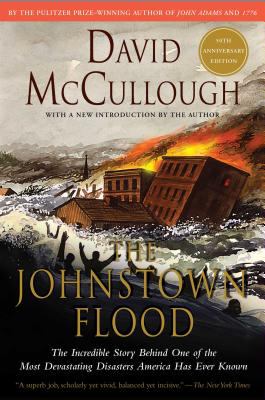
I know, those are strong words to lead anything with, but trust me, I don’t toss words around willy-nilly. When I decided to start a non-fiction history book club at the library, I knew that this had to be the first book we read because of its broad appeal – if you’re not used to reading non-fiction, it reads enough like a thriller that you’ll be sucked in anyway, and even if you are used to reading non-fiction, as I am, you’ll whip through it faster than you’ve ever read non-fiction before. That’s the strength of David McCullough’s writing. You’d never know this was the man’s first book – it’s that polished.
The Johnstown Flood happened in May of 1889, and with a death toll of over 2,200 people it was the deadliest disaster in the United States until the 9/11 terrorist attacks. The basic story is well-known – a club of wealthy industrialists from Pittsburgh bought an old dam in South Fork, Pennsylvania, turned it into a man-made lake, and didn’t make the correct modifications to the aging structure, which led to it collapsing during the storm of the century, releasing the water, and destroying town after town in the valley below, killing anyone caught in its path. The lucky ones made it to high ground in time; some fortunate individuals survived by floating on roofs, mattresses, and other debris passing by. A number of people were famously caught in a massive pile-up of debris at a stone bridge in Johnstown proper, dying there when the pile caught fire. When all was said and done, the entire town was in ruins, save for a few buildings, and thousands of people had perished. Thousands more were displaced and had lost everything, their lives shattered.
Johnstown rebuilt, of course, and started to do so almost immediately as news of the disaster spread and aid was rushed in from all over the country. Within days, Clara Barton had the American Red Cross in town, and she personally stayed there for five months. Fundraisers in major cities brought in massive amounts of financial aid. As soon as the rails were repaired, which the Pennsylvania Railroad set about doing immediately, train after train of food, clothing, and blankets arrived to help feed the victims. For those of us who were affected in some way by Superstorm Sandy, as many Hobokenites were, it would have been a familiar and welcome sight – people have always been people, and we rush to help one another whenever we can.
So if the story is so well-known to history, why read this book? David McCullough wrote it in 1968, which means that he had access to survivors who were still living, and their personal accounts of what happened and what they experienced are truly incredible. Moreover, by telling the stories of individual people in the town before he even gets to the flood, McCullough gets you invested in them and their lives, and then when the flood hits you’re left wondering which of them are going to survive. This leads you to frantically turn the pages, and before you know it, you’ve finished the relatively short book and you’re really emotional and probably angry at a bunch of long-deceased Pittsburgh millionaires. I won’t mention the names of the interviewed survivors in here so as not to spoil the experience for you, but their stories are absolutely harrowing and it’s mind-boggling that they made it out alive.
In short, The Johnstown Flood was the perfect way to start off a history book club, and it was the first book that popped into my mind when I decided to do this because I knew just how engaging a read it was. If you want to experience the events of 1889 yourself (in a decidedly safer and drier way than the people in the book), come to the second floor reference desk at the library and borrow a copy to read, then join us for a discussion of the book on January 6 at 6:30 pm in the lower level of the library. We’ll be delighted to have you, and don’t worry – after Sandy we installed flood doors down there! You can also listen to it as a digital audiobook from eLibraryNJ. You can stream a documentary about the flood on Hoopla narrated by Richard Dreyfuss .
Also check out HPL’s other book clubs this month if you enjoy Sci-Fi/Fantasy and/or Mysteries! This month you can join us for discussions of Time and Again by Jack Finney and The Alienist by Caleb Carr.
Written by:
Steph Diorio
Local History Librarian/Archivist at the Hoboken Public Library


 Hoboken Library Staff Picks