Archive | Lois Rubin Gross RSS feed for this section

Talking to Children About Death

19 Feb

When a relative or another loved one is ill or dies we, as adults, must first process our loss and take care of ourselves so that we can then take care of our children.  Much like the instruction on an airplane, “Affix your oxygen mask first,” if we cannot cope with the personal loss of a parent, grandparent, or another aging relative, we will be less able to explain with care the loss to our children.   Of course, this isn’t an ideal situation and, often, the sadness and distress that we feel is far too great to disguise when we are speaking to a child.

“Why did grandma die,” and “where is grandpa now” are probably two of the hardest questions a parent faces.  If you have a specific religious tradition that deals with death as a transition to heaven, you have guidelines in place to talk to your child. However, if you are not religious or are in a situation where mom and dad have different faiths and different traditions, you are traveling unchartered territory.

It is fairly certain that you will not use the old, “Grandma is just sleeping,” because we all know the consequences of that statement.  If grandma is sleeping, will she wake up?  If sleeping is death, will any of us wake up?  If grandma has gone to heaven, why can’t she come back for a visit?  What is heaven, and can we go visit her like we used to visit her in Florida?

Death poses some really tough questions for a parent to approach with a child.  While the following books will not answer all of your child’s questions, they will at least help to deal, in a tentative way, with the most difficult questions a child asks:

Are You Sad, Little Bear?: A Book About Learning to Say Goodbye, by Rachel Rivett.

are-you-sad-little-bear

When Little Bear’s grandmother dies, the other animals in the forest share with him the concept of loss and reassure him that saying goodbye does not mean the forgetting about a loved one.

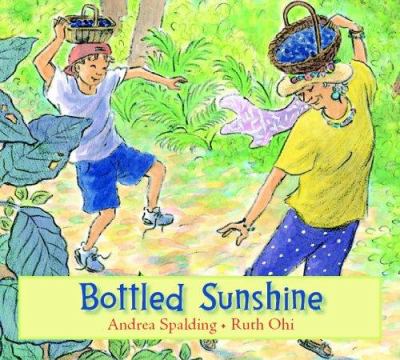
Bottled Sunshine, by Andrea Spalding.
bottled-sunshine

Sammy learns to make jam during his last visit with his grandmother, and it is this memory of a fun-loving grandparent that sustains him when she passes away.

Nana Upstairs & Nana Downstairs, by Tomie DePaola.

nana-upstairs-nana-downstairs

Four year old Tommy enjoys his relationship with his grandmother and great grandmother.  They are an integral part of his daily life.  Eventually, however, they die and Tommy must learn to deal with the fact of their loss.

The Fall of Freddie the Leaf: A Story of Life for All Ages, by Leo Buscaglia.

Image Source

This is the classic story for dealing with death.  Freddie experiences the changing seasons along with his companion leaves.  Then, as the seasons change, he learns about the delicate balance between life and death.

What’s Heaven?, by Maria Shriver.

whats-heaven

TV Personality Shriver wrote this book for her children when her grandmother, Rose Kennedy, died.  After her great-grandmother’s death, a girl learns about heaven by asking questions of her mother.  This book addresses the issue of heaven from a Catholic perspective.

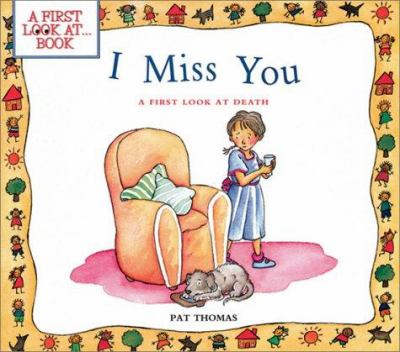
I Miss You: A First Look at Death, by Pat Thomas.
i-miss-you

A book to help children understand that death is part of life and that grief is a natural feeling when someone dies.

Sarah’s Grandma Goes to Heaven: A book About Grief, by Maribeth Boelts.

sarahs-grandma-goes-to-heaven

A young girl learns about death, funerals, and heaven when her grandmother dies of cancer.

Kaddish for Grandpa in Jesus’ Name, Amen, by James Howe.

kaddish-for-grandpa

Five year old Emily tries to understand her grandfather’s death by exploring the Christian and Jewish rituals that her interfaith family practices.

What Is Heaven Like?, Beverly Lewis.

what-is-heaven-like

Lewis, a Christian writer, shares her perspective of the afterlife. Wondering about heaven after the death of his grandfather, a boy questions his sister, a teacher, his parents and others about death and how he will see his grandfather, someday.

For Heaven’s Sake, by Sandy Eisenberg Sasso.

for-heavens-sake

Rabbi Sasso explains heaven for Jewish children and others.  After being told that his grandfather went to heaven, Isaac tries to find out what heaven is.

When Dinosaurs Die: A Guide to Understanding Death, by Laurie Krasny Brown.

when-dinosaurs-die

In simple language, the author explains feelings that people may have about the death of a loved one and ways to honor the memory of the person who died.

Why Do People Die? Helping Your Child to Understand–With Love and Illustrations, by Cynthia MacGregor.

why-do-people-die

Explains death, its effect on the living, and the rituals, ceremonies and customs that are associated with loss.

And for the parents who need to explain death to a child:

When Children Grieve: For Adults to Help Children Deal with Death, Divorce, Pet Loss, Moving, and Other Losses, by John W. James.

when-children-grieve

Compassionate manual addresses the nature of death and dispels myths about healing such as the statement that “time heals all wounds.”

Bereaved Children and Teens:  A Support Guide for Parents and Professionals.

bereaved-children-and-teens

Articles from professionals in several disciplines dealing with how to explain terminal illness, how to structure death education, and how to have rituals that help children and teens achieve closure.

How Do We Tell the Children? A Step-by-Step Guide for Helping Children from Two to Teen Cope When Someone Dies, Dan Schaefer.

how-do-we-tell-the-children

An upfront and honest explanation on talking to children about death which includes discussions of traumatic death.

Written by Lois Rubin Gross, Senior Children’s Librarian

Turn, Turn, Turn: Reading About Pete Seeger’s Times

28 Jan

Yesterday, we lost a true legend although I doubt that he thought of himself as such.  For those of us who came of age in the fifties and sixties, it is impossible to remember the world without Pete Seeger’s music.  Whenever there was a hootenanny, a song fest, a music festival replete with banjoes plinking and guitars strumming, there was Pete Seeger.  In fact, without Pete Seeger and his original group, the Weavers, folk music as an integral part of twentieth century culture might never have come to be.

Image via Wikipedia

Pete Seeger, however, was much more than a singer: he was a storyteller, first and foremost; an environmentalist; a political activist; an advocate for the rights of all men.  Moreover, he did not just stand for his principles; he went to jail for them and was blacklisted from performing because of his political associations.

I could make a long list of the hundreds of songs that Seeger recorded in his lifetime.  I could make an even longer list of the “covers” that were recorded of his songs by Judy Collins, Buffy St. Marie, Arlo Guthrie, Bob Dylan, Joan Baez, and nearly every folk-connected musician of the time period.

However, I think it is more important to portray the multi-dimensional man through books about him and his causes.  As you look at this list of books, somewhere in your mind, you will hear the plink-plink of a banjo, the strum of a guitar, and that familiar rusty voice singing We Shall Overcome.  It will become an earworm, but one worth “listening” to as it evolves into a catalog of Seeger favorites.

Hudson River Journey: Images from Lake Tear in the Clouds to New York Harbor, photos by Hardie Truesdale and text by Joanne Michaels.  Foreword by Pete Seeger.

hudson-river-journey

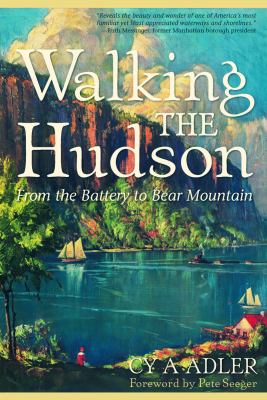
Walking the Hudson: from the Battery to bear Mountain: the First Guide to Walking the First 56 Miles of the Hudson River Trail, by Cy Adler.

walking-the-hudson

In the 1970s, the Hudson River was a chemical disaster.  Fish and animals could not live in the river.  The environment surrounding the river was being destroyed by pollution and chemical dumping.  Seeger led the movement to clean up the river and make it available to people in New York as a recreational center, again.  In 2002, he was honored for his work as an Environmental Hero.  These books show you the reclaimed river and what Seeger worked so hard to save.

We Shall Overcome: The History of the Civil Rights Movement, by Reggie Finlayson.

we-shall-overcome

Freedom Song: Young Voices and the Struggle for Civil Rights, by Mary C. Turck.

freedom-song

February is Black History Month, and it is particularly relevant that we remember the place that music held in the marches and demonstrations to the Civil Rights movement.  Frequently, the songs sung were revived gospel and spiritual music that had a place in African American history.  Always, at the front of the Civil Rights demonstrations were singers like Harry Belafonte, Joan Baez, Odetta, and Peter, Paul and Mary.  These were the songs played and sung from the bridge in Selma, to the Reflecting Pool in front of the Washington Monument, to Washington Square in New York.  The songs carried the message: we shall all be free.

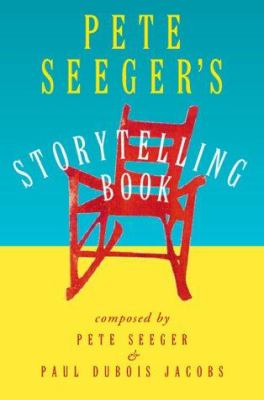
Pete Seeger’s Storytelling Book, by Pete Seeger.

storytelling-book

A gem of a book for any beginning or proficient storyteller.  Not only does Seeger share his favorite tales and practiced storytelling techniques, he also ends the book with a wonderful chapter of story beginnings with no ends.  The purpose of the chapter is to give young or new tellers a jumping off point to create their own stories.  As Seeger reminds you, people don’t come to hear a story; they come to hear the storyteller.  The important part of telling a tale is what the storyteller brings to the performance.  This is a bible for new and developing storytellers which is becoming a lost art.

Some Friends to Feed: The Story of Stone Soup, by Pete Seeger and Paul Dubois Jacobs, with illustrations by Michael Hays.

some-friends-to-feed

You may have heard this story told by Marcia Brown or Heather Forrest (my personal favorite).  It is a famous old tale of two itinerant soldiers wandering through a German village trying to cadge a meal from the unfriendly villages.  When no one offers food, the soldiers use it as a lesson in sharing with your fellow man by making a broth out of stones and encouraging the villagers to share what they can for a community meal.

One Grain of Sand: A Lullaby, by Pete Seeger.

one-grain-of-sand

This is a quiet song to share with your child at bedtime.  You will subtly reinforce the message that we live in a fragile world, one that needs to be protected, and that all of the Earth’s inhabitants are connected as one great family.

Abiyoyo, by Pete Seeger.

abiyoyo

I have been shamelessly stealing this story from Mr. Seeger for years, and it is one of my favorite to tell.  Set in an African village, it involves a young banjo-playing boy and his magician father.  Together the two are regarded as village annoyances and driven from the village. (Here is a vocabulary word for everyone: ostracize.  The boy and his father are ostracized, which means they had to go live at the edge of the village).  However, when a mythological monster, Abiyoyo, comes to destroy the village, only the father and the boy have the secret to controlling him elevating them to heroes among the townspeople.  This is a bit scary for the youngest readers, but a memorable and fun sing along for the teller to share.

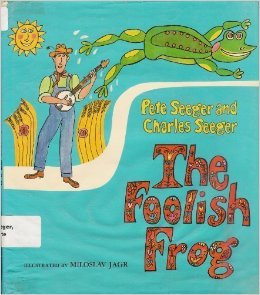
Foolish Frog, by Pete Seeger.

foolish-frog

Image via Amazon

Another tell-and-sing story as kids learn the story of the frog from “way down South in the yankety yank, a bullfrog jumped from bank to bank” and the repetitive verse sung as various farm animals.  Honestly, there isn’t much point to the story, but once you get the kids singing to tune, they’ll forget everything but the fun.  It helps if you have a banjo or a ukulele to plink along with the song.

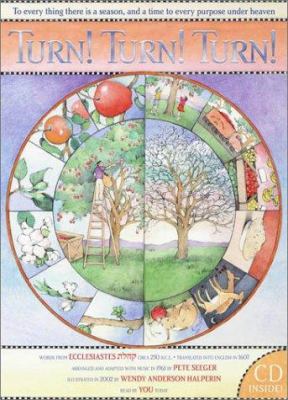
Turn, Turn, Turn: Words from Ecclesiastes Circa 250 BCE, translated into English in 1607, illustrated by Wendy Anderson Halperin.

turn-turn-turn

Beyond the Biblical reading of “To everything there is a season, and a time for every purpose under heaven,” there is the sheer beauty and poetry of this Biblical passage.  Seeger set it to music and it has been sung by many artists, most notably Judy Collins and The Byrds in the 1960s.  The pictorial interpretation in this edition is very special, dividing each verse into a circle which forces the reader to “turn, turn, turn” the page to appreciate the illustrations.  Each circle is divided in half so that readers can compare and contrast the illustrations for, “A time to plant a time to sow, a time to laugh a time to weep, a time we may embrace, a time to refrain from embracing.”  Of course, as a message of the time, the final verse is, “A time to love a time to hate, a time of war a time of peace, oh Lord, I pray it’s not too late.”  The message continues to be relevant as the world never seems to learn the lesson of peace.

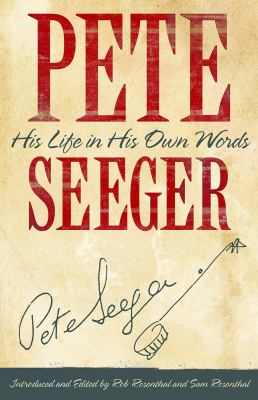
Pete Seeger: His Life in His Own Words, by Pete Seeger.

pete-seeger

This is not for children, but tells, from the pen of the man, about his early life, his political involvement, his years on the blacklist which led him to the world of children’s performance, his environmental causes, and his joyous gift of making and sharing music with the world.

Of Pete Seeger, I can only say that he lived his life long and well, he fought for his causes with courage and conviction, and he sang his songs for all the world to hear.  He will be remembered, and there’s little more that a man can ask of his life.  So long, Mr. Seeger.  It’s been good to know you.

Written by Lois Gross Rubin, Senior Children’s Librarian