Archive | Karl Schwartz RSS feed for this section

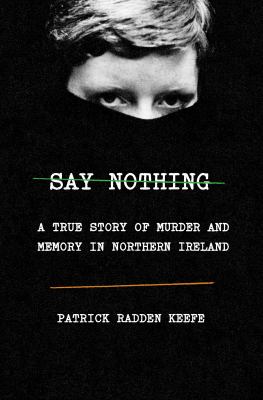
Say Nothing: A True Story of Murder and Memory in Northern Ireland by Patrick Radden Keefe

19 Jun

Say Nothing
Growing up in the 1990s, I had a vague awareness that there was a conflict in Northern Ireland between the Irish Catholic and British Protestant populations, but my understanding of what is called “The Troubles” didn’t go much deeper than that. It was hard for me to understand why Belfast was one of the most dangerous cities in the world when the rest of western Europe had entered a sustained period of peace following World War II. Say Nothing by Patrick Radden Keefe is not just a great true crime story about the unsolved crime of a mother who was abducted and murdered during this time period. It is also a great introduction to a history of the brutal violence that rocked Northern Ireland for decades and the complex historical reasons why that violence was so intractable for so long.

Most of the main characters in Say Nothing are members of the Provisional Irish Republican Army (IRA), a group who became known for their violent tactics after a peaceful civil rights movement in Northern Ireland had failed to bring about change. Many IRA members weren’t even out of their teens when they joined paramilitary gangs and helped carry out bombing campaigns against the British. Although they faced ruthless discrimination by the British, there is no doubt that the IRA was responsible for a wave of terror that killed civilians. While they were seen as folk heroes to some and terrorists to others, Keefe is less interested in condemning or praising the IRA than in exploring how people turn to violence, how we justify continuous cycles of violence, and how people reckon with their violent pasts.

The Troubles is very recent history and many of the people who participated in the violence are still alive and active in public life. Although the violence in Northern Ireland has decreased tremendously since the Good Friday Agreement of 1998, the country continues to cope with its past. The death of Jean McConville in 1972, whose unsolved murder is woven in throughout Keefe’s history of the Troubles, presents a compelling example of how extreme violence from the past can continue to effect a society decades into the future. What does truth and reconciliation look like in a country recovering from a history of deep sectarianism and paranoia?

Besides being available in print you can also borrow Say Anything as an ebook and digital audiobook from eLibraryNJ.

Interested in learning more about Ireland?  You can find documentaries with a variety of perspectives on Irish history on Kanopy including Together in Pieces: Street Art & Politics in an Evolving Northern Ireland and Collusion: The IRA Against the British Army.

Written by:
Karl Schwartz
Young Adult Librarian

George Orwell’s Best Work: Homage to Catalonia

24 Apr

Every year, thousands of high school students across the U.S. read Animal Farm and 1984 by George Orwell. Orwell’s ideas about revolution, authoritarianism, and surveillance stand the test of time because they were accurate in predicting many of the absurdities of the modern world. I still have a soft spot for these two classics, but without question my favorite book by Orwell is Homage to Catalonia, his non-fiction account of his time fighting in the Spanish Civil War.

As a young man, Orwell left England to fight for the Spanish Republic against the army of the dictator Francisco Franco. He was not alone as a foreigner in Spain, as thousands of other idealistic young men from across Europe and North America went to participate in the fight against fascism and take part in the working class uprising in the streets of Barcelona where anarchists and militant trade unions had taken over the factories and restaurants in the hopes of creating a revolutionary society.

Homage to Catalonia can be broken down into four sections. The first is Orwell’s experiences on the Spanish front, spending months sleeping in the cold and filth of the trenches in some of the most miserable conditions imaginable. The second is the description of a street fight in Barcelona between Communist, Socialist, and Anarchist militias who were all fighting against Franco, but grew to distrust each other. The third is Orwell’s miraculous survival from a bullet he takes to the neck, and the fourth is the suppression of his political party by the Spanish government which forces him to return to England.

My favorite section of the book is by far the description of revolutionary Catalonia. Orwell writes about the temporary society the anarchists had created:

“Many of the normal motives of civilized life – snobbishness, money-grubbing, fear of the boss, etc. – had simply ceased to exist. The ordinary divisions of society had disappeared to an extent that is almost unthinkable in the money-tainted air of England; there was no one there except the peasants and ourselves, and no one owned anyone else as his master. Of course such a state of affairs could not last. It was simply a temporary and local phase in an enormous game that is being played over the whole surface of the earth. But it lasted long enough to have its effect upon anyone who experienced it.”

Homage to Catalonia is essentially a tragedy as it set against the backdrop of Franco’s takeover of Spain, but one cannot help feel the excitement and ultimate disillusionment that Orwell felt during this unique time in history. Orwell’s book is not just the definitive account of revolutionary Catalonia, it is one of the best war stories ever written.

You can check out 1984, Animal Farm, Homage to Catalonia and more of Orwell’s work on Hoopla as ebooks or digital audiobooks.  Animal Farm and 1984 are also available from elibrarNJ and eBCCLS.

What is your favorite work by Orwell?  Share it with us in our comment section!

Written by:
Karl Schwartz
Young Adult Librarian