The situation we find ourselves in is not normal. That’s very evident the moment you step outside with your mask on. Hoboken’s normally bustling streets are lifeless save for the occasional ambulance or delivery person risking their own health to protect others by keeping them indoors and away from others. The playground equipment in the parks sits silently, the familiar creak of swings no longer filling the air as you walk past. When you reach your destination, most likely the grocery store, everyone is staying six feet apart. The employees are all wearing masks and gloves and are separated from the customers by Plexiglas. You escape back into your home with your groceries, wipe them all down, wash your hands thoroughly. You now have enough supplies to hunker down here for a few weeks without leaving again.
With very few changes, what I just described could also be describing Hoboken in 1918. Between 1918 and 1920, a strain of H1N1 made its way across the world, infecting and killing person after person in what became known as the 1918 Influenza Pandemic. Due to World War I, a lot of the participating nations were reluctant to initially report on the disease, but neutral Spain had a lot of coverage on the subject, and thus the strain was erroneously known for years as the Spanish Flu, as it was perceived to have originated there. Much like today, the United States had a slower initial response to the flu outbreak, with disastrous results. The first known case in New Jersey was a soldier stationed at Fort Dix who had returned from World War I, and by early October the state went into a statewide quarantine, which was eventually lifted in November as cases slowed down. The pandemic ravaged the world until 1920, but New Jersey had the bulk of its experience in the fall of 1918. Overall, approximately 10,000 New Jerseyans would die of influenza during this period, with over 2,000 of those in Newark alone due to a very lax and irresponsible response from Mayor Charles P. Gillen, which you can read about here. The United States was tragically slow to respond to the growing crisis, as can be seen by these Jersey Journal articles here:


Eventually, though, people realized the seriousness of everything and kicked into gear.


In the case of COVID-19, Hoboken has done quite well for itself – with such a large population tucked into one square mile, the city locked down earlier than most of the United States, and the proactive response is paying off – in a city of approximately 53,000 residents, 293 positive tests have been reported within the Mile Square City, which is equal to less than 1% of the population of the city. That’s honestly incredible, and it shows that a proactive response and social distancing work. Unfortunately, we’ve still lost residents here, and each loss is felt by the entire community. If we’re lucky, no more Hobokenites will fall to this virus’s spread.
The backbone of Hoboken, and indeed the entire world, during this time have been the essential workers – the grocery store and pharmacy employees, the cleaning crews, the police and fire departments, and any and all medical personnel, including the Volunteer Ambulance Corps. The same was true of 1918, as these articles from the Jersey Journal show:


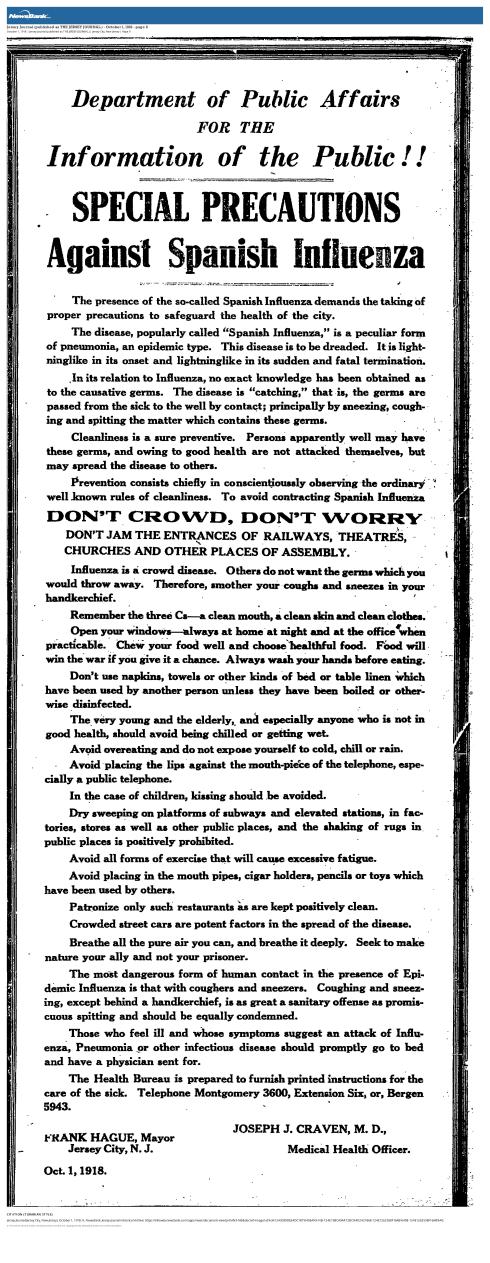
Looking at a list of how to protect oneself that ran in the Jersey Journal, it’s quite clear that many things are exactly the same:
And of course, be careful about treatment! This is a time when you’re going to see all manner of “cures” floating about, regardless of whether or not they actually work. Whilst looking for these articles, I found a few ads for some treatments that may or may not have been effective…


Lastly, as an interesting side note, when I was looking for these articles, I stumbled upon this one, which had an added element of another epidemic that followed hot on influenza’s heels: encephalitis lethargica. You can read more about encephalitis lethargica and the attempts to treat it with L-DOPA in Dr. Oliver Sacks’s landmark book Awakenings, which can be found in the BCCLS system here and is a highly recommended read!


Hoboken residents can do their own historic research in the Jersey Journal by going to our collection from Newsbank. You can check out a collection of ebooks with helpful health information for adults and kids from eBCCLS.
Stay safe out there – the library cares about you!
Written by:
Steph Diorio
History Librarian
 Hoboken Library Staff Picks