Archive | Science Fiction RSS feed for this section

Selections from the Hoboken Public Library’s Science Fiction and Fantasy Book Club

7 May

The Science Fiction and Fantasy Book Club meets monthly on third floor of the Hoboken Public Library.  Each meeting a different science fiction or fantasy book is discussed.  Many of the books we have picked so far have been considered classics of the genre.  Along with the selected works group members also often discuss other favorite books or recent reads.  The book selections are chosen by the group.  If you would like to be added to the mailing list to keep up to date about what is being read, email hplwriters@gmail.com.

The next book we will be reading will be the hilarious, The Hitchhiker’s Guide to the Galaxy by Douglas Adams on May 19 at 6 pm along with a bonus screening of an adaptation of the book on May 23 at 5:30 pm (call the library at 201-420-2347 for more details about the screening).  In June we will be reading Neil Gaiman’s American Gods.

Feed
by M.T. Anderson

feed
Though M.T. Anderson’s Feed is housed in our YA collection, adults also may find it interesting.  In the future people have computer feeds implanted in their heads.  This quick way to look things up means people’s education levels have declined.  Schools are sponsored by corporations and their main goal is to produce better consumers.  If you enjoyed the made-up slang from Anthony Burgess’s A Clockwork Orange, this book has an equally original language.  The group felt the book was heavily message driven and character development often takes a back seat to the advertising snippets.  The story centers around Titus, a typical teen who dreams of being more, and his love, Violet, a cynical teen whose feed becomes damaged.  Fans of dystopian fiction such as George Orwell’s 1984 and Margaret Atwood’s The Handmaid’s Tale may enjoy this work.

Stranger in a Strange Land
by Robert A. Heinlein

stranger-in-a-strange-land

This science fiction classic was inspired by Rudyard Kipling’s The Jungle Book and focuses on Valentine Michael Smith who was raised by Martians and then is brought back to earth as a young man.  This causes him to have a naive but insightful perspective on things like love, religion, and politics.  Most of the group read the expanded edition published after Heinlein’s death and found it may have been improved by some of the editing that was done in the original earlier edition to speed up the pacing, which occasionally gets bogged down in dialogue and description in this edition.  The group felt that its depiction of things like women’s roles and free love set it very firmly in the milieu of the 1960s even though the story is set in future.

I, Robot
by Isaac Asimov

i-robot

Despite the fact that the edition of I, Robot most of the group read featured a picture of Will Smith on the cover, the book shares very little with the 2004 movie adaptation.  The book is comprised of a series of short stories with several reoccurring characters, including Dr. Susan Calvin, a robopsychologist, who provides an overall narration of the events depicted.  The central focus of the stories is Asimov’s three laws or robotics which in a quick summation are that robots cannot harm humans, must follow human orders, and cannot destroy themselves or other robots.  Many of the stories show the difficulties that these laws may cause for example when a psychic robot lies in order to not “hurt” people’s feelings but causes more ill feelings instead or when a robot is stuck in a loop between following orders and doing something that will harm itself.  The group felt some of the stronger and more engaging stories in the book included “Robbie,” “Liar,” and “Escape!.”  And for fans of the Will Smith movie the story “Little Lost Robot” includes a few details also in the film.

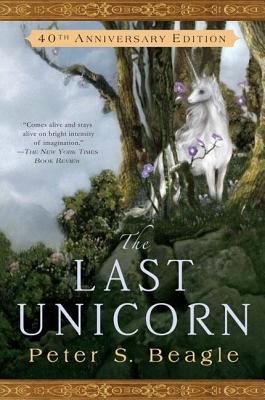
The Last Unicorn
by Peter S. Beagle
last-unicorn

The Last Unicorn was the first fantasy work for the group.  The book is considered a classic and the group member who recommended it praised its subtle clever anachronistic humor and allegorical story.  You may remember The Last Unicorn from the cartoon adaptation released in the early 1980s.  The story centers around a unicorn who thinks she is the last of her kind and goes on a journey to find others of her species.  She gains several companions including Schmendrick, a wizard who for a time transforms the unicorn into human form.  It took me a bit to get involved in the work, but for me the ending was both symbolically moving and thought provoking.  This would be a wonderful book for parents to read along with their preteens and teens.

Hope you can join us in discussing The Hitchhiker’s Guide on May 19!

-Written by Aimee Harris, Head of Reference

Imagining the Past and the Future: Neptune’s Brood and Queen Victoria’s Book of Spells

27 Sep

One of my favorite parts about reading is being able to explore new perspectives and new places.  Fantasy and Science Fiction also allow for the possibility to travel back in time to an alternate history where magical creatures exist or forward to the distance future when humans no longer do.  Charles Stross’s Neptune’s Brood is set thousands of years in the future when robots roam the universe to settle planets in honor of the dreams of their former creators.  The short story collection Queen Victoria’s Book of Spells, in contrast takes the reader back to the Victorian Era, but imagines the world alive with ghosts, witches, and fairies.

Queen Victoria’s Book of Spells: An Anthology of Gaslamp Fantasy

queenvictoriasbookspells

Queen Victoria’s Book of Spells edited by Ellen Datlow and Terri Windling contains a collection of fantasy short stories set in the Victorian and Edwardian period.  While Gaslamp Fantasy often brings up visions of Steampunk, in these stories rather than featuring dashing airship pilots and clever female inventors, there tends to be a greater focus on historical accuracy, but slipping in some elements of (often dark) fantasy.  The stories on the whole are much more interested in looking at the grittier aspects of life at the turn of the century and not simply the interesting inventions and costuming of the upper class.  The book includes original stories written for the collection.  I was familiar with some of the authors such as Gregory Maguire, Kathe Koja, and Tanith Lee, but I enjoyed majority of the stories in the book, even those of author’s I had never heard of.  There is also a nice variety throughout; one story is told through historical documents (some real and some imaginary), another is told through letters written back and forth between two authors, and another is written in an atypical second person perspective.  In two cases the stories expand on the lives of characters in period literature.  Some of the highlights of the collection for me are: Jeffrey Ford‘s “The Fairy Enterprise”, Veronica Schanoes’s “Phosphorus”, and Catherynne M. Valente’s “We Without Us Were Shadows.”  I was especially fond of the story from which the title is derived, Delia Sherman‘s “Queen Victoria’s Book of Spells.”  I liked not only the stories themselves, but also the historic notes that many of the authors included detailing the true details behind their tales.  This collection will appeal to historical fiction fans, even if they do not typically read fantasy stories.


Neptune’s Brood

neptunesbrood

Neptune’s Brood by Charles Stross mixes hard science fiction with biting satire and a bit of mystery.  Some scifi works can read almost like fantasy where the technology seems to work by magic as much as physics, but here Stross has creatively thought out and explained how even the smallest detail works.  Neptune’s Brood is set in the same reality where humans have gone extinct as another Stross novel, Saturn’s Children, but much later in time and it is not necessary to read the previous novel to understand or enjoy this work.  Krina Alizond-114 searches for her missing “sister” Ana who was “spawned” at the same time by their “mother” Sondra Alizond-1 onboard the floating starship New California.  Sondra created her “daughters” in her image, but is by no means a loving mother, but instead had kept them as indentured servants, who are trained with specific areas of specialties that she deems useful such as Krina’s background in historical accounting. This is defiantly the most action packed book about financial practices that you will most likely ever read, though truthfully it is also the only fiction book I have encountered that does so in such depth.  I found the beginning of the novel, when Krina takes a working passage on a spaceship designed like a traveling cathedral based on a religion revolving around resurrecting humanity, to be a bit slow moving, but once Count Rudi, a bat like robot pirate, shows up things pick up considerably.  When Krina arrives at the Shin-Tethys, the water world where her sister was last seen, I couldn’t put the book down.  Krina’s destination ends in a discovery that will change not only her life, but all of her society’s; her journey illuminates our own present.

~Aimee Harris, Head of Reference