
The library’s magic lantern opened up to reveal the interior. Visible are two lenses and an antique-styled light bulb.
The Hoboken Public Library’s history collection may be mostly books, photographs, and historic newspapers, but there are a few physical artifacts within our walls, as well. Part of our collection includes an antiquated edutainment device called a magic lantern and the slides that were used to do all manner of presentations at the library.
Before film and the modern projector, magic lanterns were the best way to produce a slideshow – think of them as 19th century PowerPoint presentations, but sometimes with added special effects if the show was aiming to be more entertaining than educational. The technology for the magic lantern was first properly developed by Christian Huygens in the 1600s, magic lanterns really took off in the 18th and 19th centuries as a form of entertainment and as a method of illustrating lectures and other educational events. The heyday of the technology was in the middle and late 19th century and early 20th century; as mentioned above, film eclipsed the entertainment aspects of the magic lantern during the 1920s, and although magic lanterns continued to be used to project previews onto the screens before and after movie screenings, they were eventually replaced by the projector, as well. The technology used in a magic lantern is relatively simple – it utilizes lenses and a light source to project an image on a glass slide onto a screen, and much like a modern day projector it can be adjusted for focus depending on its distance from the screen. To see this more easily, here’s a photo of our own magic lantern opened up:
As you can likely see in the image above, our magic lantern utilizes a lightbulb, which immediately dates it to post-1879, when lightbulbs became commercially available following Edison’s patent. During my research on our lantern, I was able to locate a sibling lantern of sorts that had once been for sale online. Both were manufactured by Charles Beseler and Co., a company still around today (albeit as a supplier of photographic equipment). The serial number on our model is 2031; the seller’s model had the serial number 2357, making it slightly younger than our own. Their date estimate was the late 1910s-early 1920s, which seems about right given the circumstances. Hoboken Public Library has been in the current building since 1897, and although I’ve so far been unable to confirm exactly when we acquired the lantern, I’ve heard that the library did use it for programming, so those dates would likely line up well. The box our lantern is contained in refers to it as a B-1, which is likely the model number, but I haven’t been able to get my hands on an old Charles Beseler and Co. catalogue to confirm this yet.
I took quite a few photos of our magic lantern before packing it up to store it with the rest of the history collection during the renovation process on the second floor. Although we have the reference and history collection in storage, you can still find temporarily computers and seating for adults on the third floor. Here’s a selection of the photos I took:
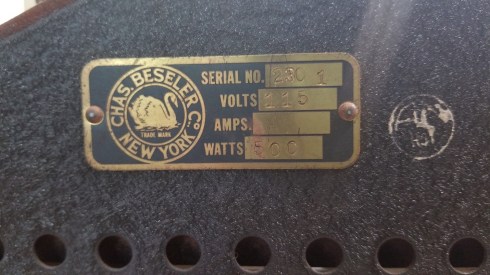
The serial number and the Charles Beseler and Co. logo, a swan on a lake.
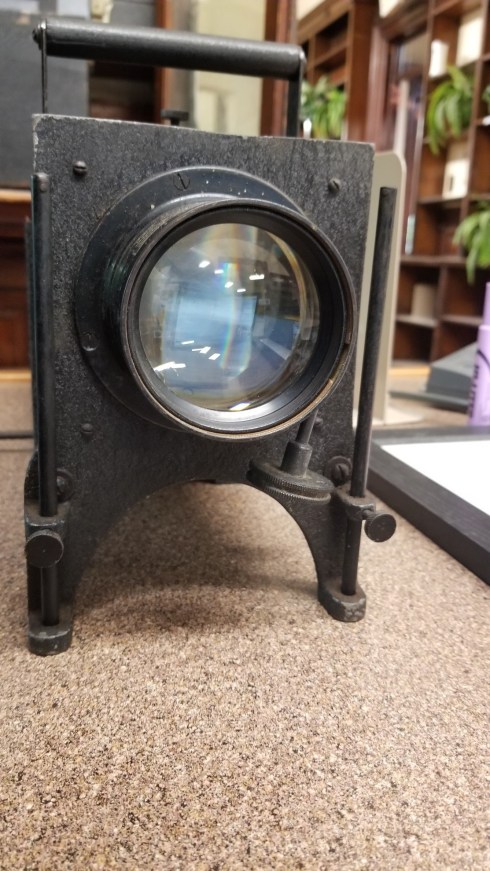
A better shot of the lens from up front.

A selection of some of the slides the library has. The slide collection is actually quite vast!
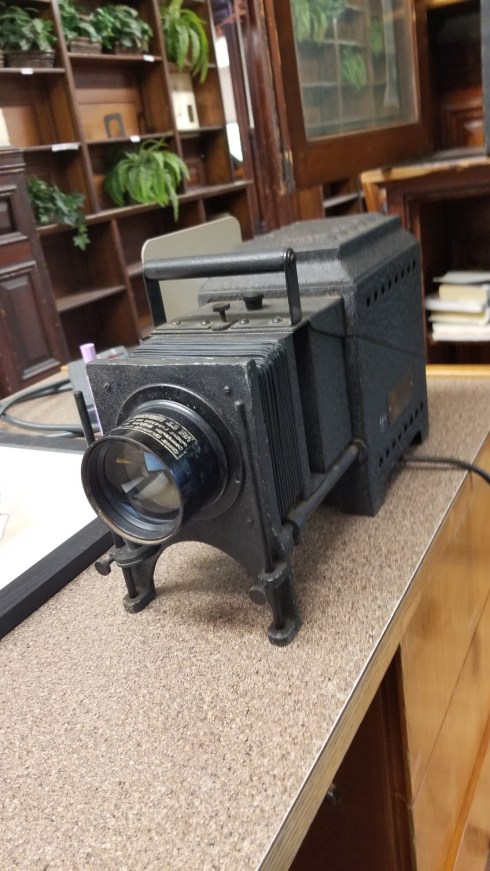
The lantern is actually lighter than it looks at first glance, and the handle makes it easier to move around and set up when it’s not in its box.
At the moment, our lantern is sitting dormant, but we’d love to get it into full working order and do a proper magic lantern program here at the library. Hopefully in the near future once this phase of the second floor renovations are complete we’ll be able to put on a little show for you all! Until then, stay tuned for more history content (especially as I unpack it all once the renovations are done – thank you for your patience!). You can always access digitized versions of parts of our collection online. Another great source for Hoboken historic materials is the Hoboken Historical Museum (check them out if you haven’t)!
You can check out the library’s high tech modern version of the Magic Lantern, the immersive virtual reality Oculus during our Open Makerspace Time on Mondays from 1 PM-7 PM in the library’s lower level programming space!
Written By:
Steph Diorio
Local History Librarian/Archivist at the Hoboken Public Library
Tags: Charles Besler and Co, hoboken, Magic Lantern
 Hoboken Library Staff Picks