Archive | January, 2015

Say Yes Please to Yes Please

14 Jan

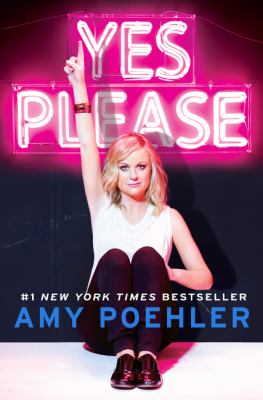
I’ve long been a fan of Amy Poehler’s. My favorite movie of hers is Wet Hot American Summer, which came out before she appeared on Saturday Night Live and will soon be revived as a TV show on Netflix. I follow Amy Poehler’s Smart Girls at the Party on Facebook, Twitter, and Instagram. Not only is she funny, but she seems down to earth. When I heard she wrote a memoir called Yes Please, I couldn’t wait to read it.
yes-please

Amy chose the title Yes Please because the word “yes” calls back to her improv days (saying yes is the first rule of improv), and “please” means you’re agreeing to not do something alone. She also likes to use the phrase in her personal and professional life. I like that it sounds polite.

Yes Please is written like a series of essays. In the early chapters, Amy describes her family and growing up in suburban Boston, where not much happened so she compensated for that with an active imagination. She also gives helpful life advice, such as “treat your career like a bad boyfriend.” There are several shout-outs to Judge Judy, who I also admire.

Improv has played a huge role in Amy’s career and life. She fell in love with it while playing Dorothy in a grade school production of The Wizard of Oz. She writes about her time with the Upright Citizens Brigade improv group, where she met Tina Fey (whom Amy calls her “comedy wife”, and gets a chapter in the book), Rachel Dratch, Stephen Colbert, among others.

There are stories about her time on SNL, good and bad. (Although she doesn’t dish about which celebrity hosts behaved badly.) She writes about making her SNL debut after 9/11, which was poignant. I remember watching that first episode later that September, where in the cold open SNL creator Lorne Michaels asked then-Mayor Rudy Giuliani for “permission to be funny”. Amy admits to laughing on-air during a Debbie Downer sketch. The characters in the hilarious Bronx Beat sketches, performed with Maya Rudolph, were named after two ladies in the SNL hair department. In the chapter “Sorry, Sorry, Sorry”, Amy talks about a skit that offended a mutual acquaintance that she took a long time to apologize for and her regret over the delay.

It’s hard to choose a favorite chapter from Yes Please, but a contender is “The Day I Was Born”. Amy believes everyone should know about the day they were born. She tells her birthday story, with input from her parents. This prompted me to ask my parents about the day I was born. One highlight from my birthday, according to my mom, is when she found me in the nurse’s station hours after I was born having my hair combed by two nurses. I was born with a full head of red hair, and stood out from the other babies in the nursery.

Amy wrote an entertaining chapter about being nominated for major acting awards like Golden Globes and Emmys, which she nicknamed “the pudding”. To make the experience more fun and less stressful, she planned bits with her fellow Best Actress in a Comedy Emmy nominees. At the 2011 Emmys, Amy and the other nominees came on stage as their names were called and held hands like pageant contestants waiting to hear who gets the crown. The winner Melissa McCarthy received a bouquet of roses and a tiara in addition to “the pudding”.

After I read Yes Please, I loved Amy even more. I’m planning to listen to the audiobook of Yes Please, just so I can enjoy this wonderful book again.

This is my second post about funny lady memoirs, which I plan to continue as a series. (The first post was about Tina Fey’s book Bossypants.) Rachel Dratch has a memoir that I want to read. I’d love to read memoirs by other SNL performers, such as Maya Rudolph, Ana Gasteyer, and Kristen Wiig. Publishing execs, please give these ladies book deals!

Who are your favorite funny ladies? Do you know the story of the day you were born?

-Written by Kerry Weinstein, Reference Librarian

Martin’s Children

7 Jan

January 15 is the 86th anniversary of the birth of Dr. Martin Luther King, the legendary Civil Rights Leader. The Hoboken Library and other BCCLS libraries have countless books on Dr. King and his legacy.  However, it is even more interesting to read the stories of the people who were inspired by Dr. King to foment change in our country, or even those who predated Dr. King by fighting Civil Rights’ battles before the protests and demonstrations of the late 1950s and early 1960s.  In this list of books, I have assembled only a small sampling of books about people who actually put their lives on the line to bring about change.  Most of these books are aimed at slightly older readers, perhaps from fourth grade through teens, because the subject matter is often hard to explain to younger readers.  For these children, it is appropriate to focus on Dr. King and Rosa Parks, the most identifiable and most written about figures of the Civil Rights’ Movement.  However, slightly older readers can expand their reading to include people, often students of their own age, who showed incredible courage to bring about the necessary change to our country.

(Click the images for links to the catalog.)

The Girl From the Tar Paper School: Barbara Rose Johns and the Advent of the Civil rights Movement, by Teri Kanefield.

girlfromthetarpaperschool

“And the children shall lead.”  This is the story of a Virginia high school student who led a 1953 strike to get her ramshackle “separate but unequal” school brought up to viability.  When local groups would not back her on this crusade, she became a driving force, through non-violent protest, in getting schools integrated so that African American students would attend schools of equal quality to their white counterparts.

Child of the Civil Rights Movement, by Paula Young Shelton.

childofthecivilrightsmovement

The daughter of activist/politician/UN Ambassador Andrew Young shares her memories of growing up in the Civil Rights movement.  She speaks specifically about experiencing Jim Crow laws as a child, when she could not enter restaurants and movie theatres patronized by white people.  She also recalls sitting underneath the family table as Dr. Martin Luther King and her parents planned non-violent action.  As a four year old child, Shelton was taken by her parents to the historical march in Selma, Alabama.

As Good as Anybody: Martin Luther King Jr. and Abraham Joseph Heschel’s Amazing March Toward Freedom, by Richard Michelson.

asgoodasanybody

Two great men, both religious leaders of their own people, led parallel lives that led them to reach out to one another at a particular time in history.  Rabbi Abraham Heschel had experienced, first hand, discrimination against Jews in Europe and learned from his father’s wisdom to, “Walk like a prince not a peasant.  You are as good as anybody.”  In different words and different ways, Dr. King learned and conveyed the same lessons as they walked, side by side, in the march in Selma, Alabama.

We Shall Overcome, the Story of a Song, by Debbie Levy.

weshallovercome

It started as a hymn sung in African American churches, but it became a mighty anthem and the song most associated with the Civil Rights movement.  The lyrics conjure the unity and determination of a movement: “Deep in my heart, I do believe, that we shall overcome someday.”

Sit-In: How Four Friends Stood Up by Sitting Down, by Andrea Davis Pinkney with illustrations by Brian Pinkney.

sit-in

The husband-and-wife team join their talents to tell the story of the lunch counter protests of 1960 became a part of history.  Through well-chosen words and food metaphors, Ms. Pinkney recounts the action of the seed group of four students who sat, politely, at a luncheonette counter in a “white’s only” area and asked to be served as equals.

The Voice that Challenged a Nation: Marian Anderson and the Struggle for Equal Rights, by Russell Freedman.

voicethatchallenged

The premier writer of juvenile non-fiction tells the story of Ms. Anderson, a child of Philadelphia, who developed her amazing contralto voice in church choirs.  Discriminated against in the United States, she went to Europe and trained to be a concert artist but, when she returned to her own country, she was prevented from performing in many venues.  The most notable act of discrimination occurred in 1939 when Anderson was forbidden by the Daughters of the American Revolution (DAR) from performing at Constitution Hall in Washington, D.C.  Championed by none other than Eleanor Roosevelt, the concert was moved to the Lincoln Memorial where Marian Anderson’s voice reached 75,000 people on the National Mall and thousands more through radio transmission.

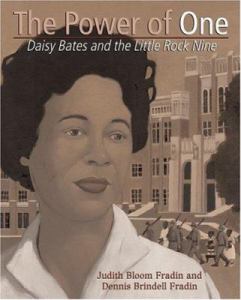
The Power of One: Daisy Bates and the Little Rock Nine, by Judith Bloom Fradin.

powerofone

It took one woman to be an instrument of change.  This is the story of Daisy Bates who served as a mentor to the nine courageous young people who, under Federal guard, integrated Central High School in Little Rock, Arkansas.  Despite death threats and personal harassment, Daisy and her group faced down a hostile community led by Governor Orval Faubus who blocked the doors of the high school to prevent the entrance of the Black students.

We’ve Got A Job: The 1963 Birmingham Children’s March, by Cynthia Levinson.

wevegotajob

This is the story of the historic march on Birmingham told through the eyes and personal recollections of four people who participated.  Audrey Hendricks, Washington Booker III, Annetta Streeter, and James Stewart represented different aspects of the Black community, yet they came together to take part in this protest.  There were approximately 4000 young people involved in the protest, and 2500 of them were jailed for their participation.  The book also highlights the life of Fred Shuttlesworth, a compatriot of Dr. King’s whose work is less well known.

The Case for Loving, by Selina Alko.

caseforloving

(This book will be published in 2015).  Until 1958, it was illegal for people of different races to marry in many states under miscegenation laws.  A Virginia couple who had married in Washington, D.C. and then returned to their Virginia home to raise their family, Richard and Mildred Loving were subsequently arrested for breaking the law prohibiting interracial marriage and became the test case in the U.S. Supreme Court that overturned these discriminatory laws and upheld their marriage as lawful.

The most amazing thing to me is that most of these books are far from ancient history.  Children can easily find older family members and members of their communities who can recall viewing the events of the 1960s on their small-screen television sets.  Meanwhile, it is important to understand the scope of the work that Dr. Martin Luther King and his compatriots carried out through books and films available through the library.

-Written by Lois Rubin Gross, Senior Children’s Librarian