Archive | April, 2013

Number 42 for Kids

10 Apr

jackierobinson

This week, a new movie will hit the theaters highlighting the life and career of Jackie Robinson, number 42 on the Brooklyn Dodgers.  Robinson, the first African American to play major league baseball, played until 1957, but it is his very early years that are most noteworthy.  The story of Jackie Robinson is one of perseverance and bravery, but it is also the story of the men who enabled Robinson to become a pioneer in baseball.  Branch Rickey, the President of the Dodgers, could have picked the potentially more talented Josh Gibson or Satchell Paige to be the first Black player.  However, he counseled Robinson that he would need fortitude to ignore the taunts and abuse that he would undoubtedly receive from the stands.  Among Robinson’s supporters was Hank Greenberg, a Jewish player who understood the mistreatment Robinson would receive, and the Southern-born Pee Wee Reese, an unlikely booster, but a friend to Jackie for life.

There have been many children’s book written about Jackie Robinson and his career, but perhaps more importantly was the impact of the man on people that post-War America considered “outsiders.”  The following books are both biographical tributes to Number 42 and books that fictionalize how young people viewed this heroic man who earned his place in sports’ history by standing strong. To reserve a copy of any of these books, just click on the book title and you will be taken directly to the library’s catalog 🙂

In the Year of the Boar and Jackie Robinson

In the Year of the Boar and Jackie Robinson, by Bette Bao Lord is the story of a young Chinese girl who owes her Americanization both to baseball, her ability to play stickball (the street version of baseball, but you have to be from a particular kind of neighborhood to know the rules), and to her devotion to her hero, Jackie Robinson.
TestingTheIceCover

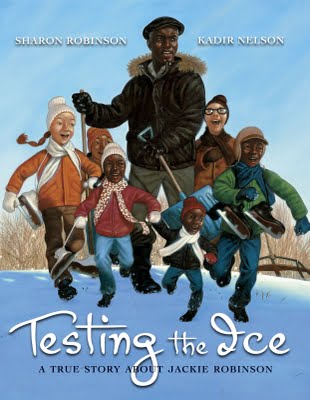
Testing the Ice, by Sharon Robinson and Kadir Nelson, is a personal story, told by Jackie Robinson’s daughter, about how her seemingly fearless father had one very real fear.  He was afraid of water, having never learned to spring.  On a winter’s day, he finally challenges his own apprehensions by walking to the center of a frozen pond illustrating for his daughter the courage that made the man.
DadJackieAndMe

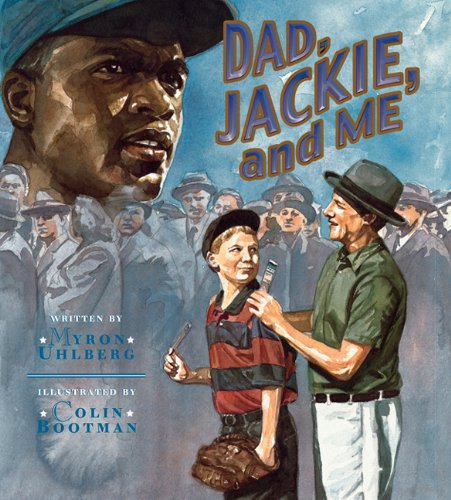
Dad, Jackie and Me, by Myron Uhlberg and illustrated by Colin Bootman, shows how important Robinson’s success was to all outsiders.  In 1947, Uhlberg would go to Dodgers’ games with his hearing impaired father.  While his father did not understand the game, he clearly understood the hatred being aimed at Robinson when he went on the field.  It was Robinson who inspired Uhlberg’s father to learn about the national past time and also talks about little known “Dummy” Hoy, a hearing impaired player who played for fourteen years in the major leagues.

when-jackie-and-hank-met

When Jackie and Hank Met, by Cathy Goldberg Fishman with illustrations by Mark Elliot, is the fleshed out story of the brief collision on the field between Jewish player Hank Greenberg and Jackie Robinson, and how Greenberg’s encouraging words forged a lifelong friendship.

0316340944

Snow in August, by Pete Hamill, is one of my all-time favorite books.  It is for older readers and adults.  I would comfortable give it to a good reader of 12 years through adult.  It is a coming-of-age story in much the same way that A Tree Grows in Brooklyn is.  After World War II, Rabbi Hirsch, a concentration camp survivor, moves to Brooklyn and opens a small synagogue.  He turns to a young neighborhood boy, Michael Devlin, to do small chores for him that cannot be performed by a religious Jew on the Sabbath. As Michael and the Rabbi become friends, they bond over baseball and Jackie Robinson.  Both admire Robinson’s ability to stand up to bullies, much like the bullies who terrorize their Brooklyn neighborhood.  When the neighborhood toughs break into the synagogue looking for what they think is a treasure of Jewish gold, Michael digs into Jewish mythology and creates a golem, a giant creature charged with protecting Jews against anti-Semites. The post-war atmosphere and the need for a superhero to fight against discrimination plays in well to the story of Jackie Robinson, and will gently teach young readers how hatred festers when good men do nothing.  A truly memorable book.

With the baseball season now in full swing, these and other books about Robinson, the Negro Leagues, the All-American Girls Baseball League, among other heroes, will show young readers an entirely different side of a sport we consider uniquely American.

– Lois Rubin Gross, Senior Children’s Librarian

Theatre for the Mind

1 Apr

Long ago and far away, just after the dinosaurs roamed the earth, there was this thing called radio. I’m not talking about top-forty hits radio, or Sirius radio in your car. This was a console radio with buttons and dials that sat as a central focus of everyone’s living room, and from this wonderful instrument spilled out Big Band music, girl singers, soap opera and children’s shows like a storytelling program called Let’s Pretend. Anyone who attends my story times is familiar with the Let’s Pretend theme song because I use it to open and end each story time. There was also a wonderful performer named Kate Smith and it was on her show that I was introduced to Story Princess who enchanted me with her stories for children.

Thanks to a sister who was a born teacher, I read early so it wasn’t really necessary for my parents to read to me, but I frequently read out loud to my own daughter. Even when I had to work evenings (which, as a librarian, is a given), I made tapes of favorite stories that she could hear at bedtime.

I think there is a magical connection established when parents read aloud to children, or when anyone reads aloud to children. Not only are electronic devices turned off so that you can have human contact with the child, but you likely have the child’s undivided attention for the length of the reading. For children who have been raised with an assault of images, reading allowed exercises a different set of brain waves, ones in which the child exercises imagination to create their own mental images of what an author is describing. Too often, these days, we take the imagination out of stories giving young readers 3D, pop-off-the screen pictures that deny them the opportunity to think for themselves. If we want the next generation of artists, writers, and even inventors, this ability to conceptualize is critical to the process.

Also, keep in mind that reading out loud helps your child to develop vocabulary above their reading level. Children listen at a higher level than they read and to experience new words, phrases and concepts an adult voice is a great addition to the process. Also, don’t forget that, when you have finished reading, it is good to talk to your child about what they’ve read. Not only will this help you to see your child’s level of comprehension, but it will also give you insights into how your child views the world.

The Hoboken Library is in the process of acquiring a collection of titles for parents to help you select books for reading aloud. Books like Jim Trelease’s The Read Aloud Handbook (Penguin Books 2006), and Pa, Allyn’s What to Read When (Avery, 2009) will help you to select age and interest-appropriate books for your child. Also, many websites, such as  www.goodreads.com will help you to make selections.

Meanwhile, here are some books that you may remember from your own childhood that you will want to share with your child. (Note: These are all chapter books designed to be read with slightly older readers. There are many wonderful picture books for little ones, but chapter book read-alouds get less attention and I’d like to feature these).

Click on the links on each title to go right to the library’s catalog to reserve a copy online!

MatildaMatilda, by Roald Dahl.
Having just seen the Broadway musical of this darkly funny book about a gifted five year old, sadly mistreated by her foolish and cruelish parents, It is on my mind to recommend. Matilda is a wonderfully, humorous, satirical book that actually highlights the dangers of too much “telly” as Matilda, our heroine, glories in the good of books. The school’s head mistress, Miss Trunchbull, is the stuff of nightmares, but there is a lovely teacher, Miss Honey, and a kind librarian who encourage Matilda’s imagination and love of books, and it all works out well, in the end.

despereaux

Tale of Despereaux, by Kate diCamillo.
This was made into a wonderful animated movie, several years back, so after you’ve read the story of the plucky little mouse who, with a rat and a servant boy, conspire to save a princess, you might borrow the movie from the library and compare and contrast. Which version does your child like best? Is the story as they pictured it in their mind’s eye?

Mrs.-Piggle-Wiggle

Mrs. Piggle Wiggle, by Betty McDonald.
When I was in first grade, the greatest reward our teacher could offer was a session of reading out loud from Mrs. Piggle Wiggle. Yes, it’s been around that long, and it still holds up. The story of the rotund little lady with magic cures for children’s bad behavior begs to be read aloud. Don’t hesitate to act out the cures (especially The Whispering Cure for gossipy little girls). All of these stories are a bit moralistic, but the fun is so enormous that no one notices.

9781416928171_p0_v1_s260x420

Bunnicula, by James and Deborah Howe.
Chester, the cat and Harold, the dog are suspicious of the newly acquired bunny who has joined their family’s menagerie. Somehow, the vegetables in the refrigerator have developed a tendency to lose their color, and the cat and dog suspect that the pink-eyed bunny is a vampire rabbit. When they hear that you get rid of vampires by putting a steak through their heart, it’s a hop, skip and a jump to the meat section of the refrigerator.

ibbotsonplatform13

Secret of Platform 13, by Eva Ibbotson.
If you have children who are not quite ready for Harry Potter, start them on Eva Ibbotson. In fact, even if they’ve read Harry Potter, Eva Ibbotson’s books are wonderful fantasies which are more concise, but no less magical than J.K. Rowling. In this book, my favorite, a secret door opens under a train track every nine years, allowing access to a magical island. Nine years ago, a prince was kidnapped, and an ogre and a young wizard set out to save him, never knowing that he has become so spoiled they might just decide to give him back.

When you read aloud to your child, you share a bit of yourself, both from the selection of books and how you present them. The gift of reading is something you will always want to make a family event.

– Lois Rubin Gross, Senior Children’s Librarian